It's time for more mystery streetcars! Today I'm turning my attention to a pair of streetcars preserved at the Ballard Terminal Railway in Seattle. The Ballard Terminal, whose owner I believe also owns these two cars, has a very short "yard" just off of West 45th Street in Seattle which consists of a single curving siding. At the end of the siding sits an Oporto single-trucker, but I'm not particularly interested in that car because it doesn't qualify for inclusion in the PNAERC list. However on the ground along the fence are two car bodies that probably do qualify: a Birney and a double-truck turtleback roof car of (presumably) Stone & Webster design. They're visible on Google aerial photos and the roof of the double-trucker can be seen on Google Street View.
So... anyone know what these cars are? I know that Seattle Municipal Railway had both turtleback-roof cars and Birneys, as did - I believe - Tacoma Railway & Power. Both of those lines can boast of only a single Birney body currently on the PNAERC list so assuming the two Ballard cars are local they are fairly significant.
Saturday, September 9, 2017

Friday, September 8, 2017
Dallas/Boston PCC scrapped
I can't recall offhand the last time that a car on the PNAERC list went directly from "undergoing restoration" to "scrapped" but I suppose there's a first time for everything. It was brought to my attention that this summer the McKinney Avenue Transit Authority in Dallas scrapped the ex-Dallas double-ended PCC car that had arrived there only a year and a half earlier.
 The car was built by Pullman-Standard as Dallas Railway & Terminal 612, becoming Boston MTA (and later MBTA) 3334 in 1959 when it was sold for use in Massachusetts. In 1991 it was acquired by Trolleyville and moved to Cleveland, where it was stored indoors for most of the time until the Trolleyville collection was liquidated in 2009. At that time it was acquired by MATA but, lacking storage space, it was moved to the Illinois Railway Museum and stored there. It was moved to Dallas in December 2015.
As recently as early 2017 the car was undergoing a major rebuilding with the goal of making it operational; it had been stripped down to the steel shell and the entire car had been sand-blasted. But it seems that the frame was more heavily deteriorated than expected and McKinney decided that it would be uneconomical to repair the car for operation. So in May or June it was cut up. It's worth remembering that MATA is not a museum; they're basically a tourist railroad with a franchise to provide a public transportation service. So their primary mission isn't to preserve or restore Dallas streetcars, it's to provide reliable service along their street railway route.
Car 612 was far from unique. A dozen other other members of this class exist in various museums, though none in operating condition and only a couple retained as accessioned collection pieces. But all of the other examples are located in the northeast - none in their original home in Texas.
Thursday, September 7, 2017
Black Hills Central update
As I did some web surfing looking for more information on Utah interurban cars, I came across an update on Bamberger 403. This classic Jewett wooden interurban car was built in 1910 as a motorized combine but was later rebuilt by Bamberger as a coach trailer. It strongly resembles (well, resembled) cars built for the North Shore Line in Chicago, of which none survived.
 But it doesn't resemble them much any more. It was stored in steadily deteriorating condition at the Heber Valley Railroad in Utah until 2012, when it was sold to the Black Hills Central and moved to South Dakota. It appears, from an ATRRM blog post, that the BHC rebuilt it last year for use as a locomotive-hauled coach. It fits in well with the other ex-interurban cars in their regular train, the others being from the Oregon Electric, but it's too bad that the car has lost much of its classic appearance to a somewhat clumsy, if admittedly pragmatic, rebuilding. That said, the car wasn't exactly complete and original when it went to South Dakota, and at BHC it should be well maintained.
Wednesday, September 6, 2017
Saltair additions and a deletion
So it came to my attention, due to a thread over on RyPN, that the Utah State Railroad Museum in Ogden has a pretty nice online roster which includes a fair amount of information on their collection - including the four pieces of traction equipment they own. Only two of these, Bamberger "Bullet" car 126 and Salt Lake & Utah freight trailer 851, were already on my roster. The other two, big Salt Lake Garfield & Western ("Saltair") open car trailers whose numbers are unknown, were not on my roster. That has now been corrected.
 The two cars (now on the roster here and here) are from the 301-313 series of cars, built in the company shops in 1922 using parts from older 1890s-era freight cars. The museum's website roster has a great deal of mechanical information on these cars which has also allowed me to flesh out the listing for an identical car at the Western Railway Museum in Rio Vista (that car is thought to be fleet number 306). Both of the cars owned by the Ogden museum are stored, along with the Bamberger "Bullet" car body, at the Ogden Business Depot on the north side of Ogden near the county fairgrounds. The Google Maps aerial photo above shows, from left to right, one of the open cars; the "Bullet" on a flatcar; the other open car; and the remains of dome car "Moon Glow." There's also a brief article (with photos) about the open cars, forecasting a restoration which I believe has not yet happened, at this link.
And the roster linked above also contained a piece of information about yet another example of these big Saltair open cars which I was able to confirm independently, namely that the fourth of the previously surviving examples of this type was scrapped at the Heber Valley Railroad in 2009 following serious damage from a fire set by an arsonist. So that car has been removed from the roster, leaving Heber Valley on the PNAERC list with only three Lackawanna MU cars used in locomotive-hauled train service.

And the roster linked above also contained a piece of information about yet another example of these big Saltair open cars which I was able to confirm independently, namely that the fourth of the previously surviving examples of this type was scrapped at the Heber Valley Railroad in 2009 following serious damage from a fire set by an arsonist. So that car has been removed from the roster, leaving Heber Valley on the PNAERC list with only three Lackawanna MU cars used in locomotive-hauled train service.
Tuesday, September 5, 2017
MBTA 01400s running
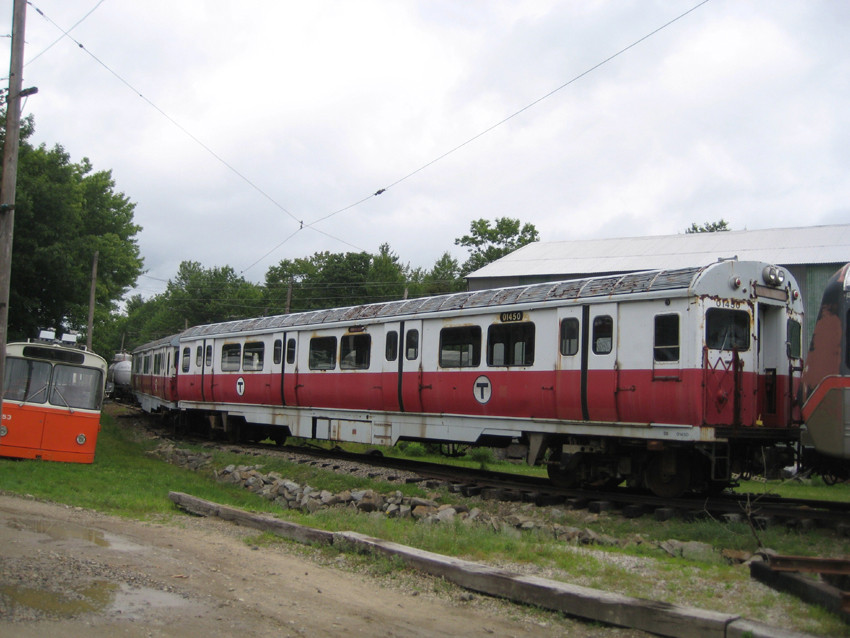
2009 photo by Jason Grant
Within the last couple of weeks Seashore volunteers have gotten their married pair of MBTA 01400 series Red Line subway cars operating. These cars came to Seashore in 1997 following retirement from service but have operated little, if at all, during the last 20 years. But museum volunteers have now mounted trolley poles (unprototypical, but necessary for operation) to the car roofs and gotten the pair running. It's not clear how much use they'll see, or whether they're cleared for public/revenue operation, but their status on the list has been changed to "operated occasionally."
The 69'-long 01400s were the last Red Line cars built of steel and the last cars built for that line before the MBTA took over from the Metropolitan Transit Authority. They were constructed by Pullman-Standard in 1963 and originally wore a flashy (for subway cars) livery of dark blue and white with gold striping. Seashore is currently raising money to repaint its pair in that original, and unique to this series, color scheme.
Wednesday, August 30, 2017
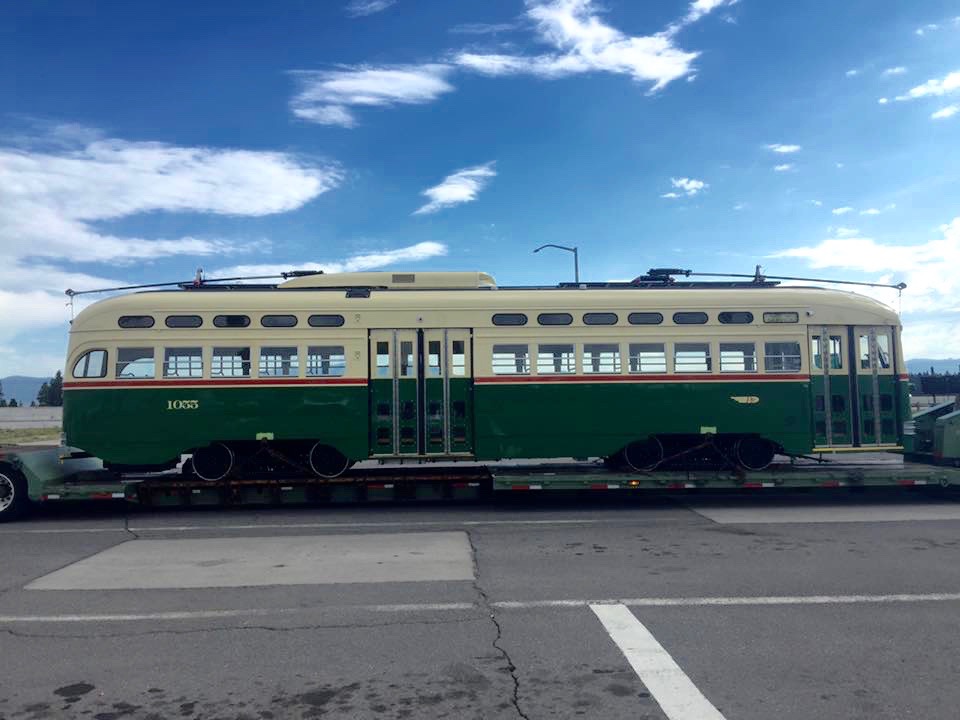
More Muni PCC rebuilding news
Tuesday, August 29, 2017
Mining locomotives added
This is another "catching up" post, but back a couple of months ago I decided to add a pair of Phelps-Dodge mining locomotives to the list of preserved equipment. The problem is, I don't have fleet numbers for them.
 Both of them are in Douglas, Arizona outside of the city visitors center at 16th & Pan-American Avenue. Until a year or two ago they were plinthed in a parking lot at 11th & H Avenue but their new home is higher-visibility. The first, pictured here, is one of the homebuilt locomotives that Phelps-Dodge constructed around 1906. Three others exactly like it, fleet numbers 15, 17, and 18, are still around and owned by Old Pueblo Trolley, Arizona Street Railway Museum, and Goldfield Ghost Town respectively. It's now on the PNAERC list here.
 The second, pictured here, was (according to the caption at the link) built by Baldwin-Westinghouse in 1918. It looks very similar - but intriguingly, not identical - to Phelps-Dodge 2, currently on display (if only marginally preserved) at Goldfield Ghost Town. It's now on the list here. This locomotive may have Westinghouse HL control, as does number 2, but I just don't know.
I'm very interested in fleet numbers for either of these locomotives, so if anyone is passing through Douglas, I'd appreciate it if you could stop by and scout these out! Also, if you're interested in all of the preserved Phelps-Dodge locomotives, just click here. There aren't all that many industrial electric locomotives on the PNAERC roster - small-gauge mining locomotives, for instance, don't fit into the criteria I've developed - but these Phelps-Dodge locomotives are standard gauge and ran using the same type of overhead as most street railways. Some even had Westinghouse HL control. So they're still pretty interesting even if they never ran alongside 62' interurban cars or deck-roof streetcars.
I'm very interested in fleet numbers for either of these locomotives, so if anyone is passing through Douglas, I'd appreciate it if you could stop by and scout these out! Also, if you're interested in all of the preserved Phelps-Dodge locomotives, just click here. There aren't all that many industrial electric locomotives on the PNAERC roster - small-gauge mining locomotives, for instance, don't fit into the criteria I've developed - but these Phelps-Dodge locomotives are standard gauge and ran using the same type of overhead as most street railways. Some even had Westinghouse HL control. So they're still pretty interesting even if they never ran alongside 62' interurban cars or deck-roof streetcars.
Subscribe to:
Posts (Atom)