Saturday, January 30, 2021

New car added to list

I was alerted, by a post on a Facebook group by Murphy Zane Jenkins-Henson, to the fact that there is a car from the Southwest Missouri that is preserved, and even on public display, but missing from my list. And we can't have that.

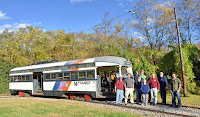
And here it is, in all of its dubious glory, on public display in Carterville, Missouri. It says "No. 66" on the side but that's not its number - presumably that was put on there because it's along Route 66. And the best part is that it is next door to, and may indeed be owned by, the Superman Museum (which doubles as an ice cream parlor). So now the Superman Museum is included on PNAERC.

The Southwest Missouri did have a car numbered 66 but it was a big deck-roof wood car similar to car 60, preserved in Webb City. This car, or what remains of it, is definitely from the 91-95 series of lightweight suburban cars that were turned out by Southwest Missouri's Webb City shops in 1927. They were homely looking cars (see here for an in-service photo) but were the most modern to run on the system and probably ran until the end of electrified passenger service in 1938. What information I have on these cars comes from a book called "Tri-State Traction" by Edward Conrad and that books says that these cars had K-84 controllers, which is the first reference I've come across to that type. So that could be a typo, I don't know. The book also says that three of these cars - 91, 93, and one other - were sold in 1940 for use as a restaurant in Chetopa, Kansas. In 1984 two were scrapped and the third was brought to Carterville, where it remains.

Friday, January 22, 2021

Jersey Shore streetcar added to list

Many thanks to Bill Wall, who has alerted me to an article written in the latest Friends of Philadelphia Trolleys newsletter by another friend of the blog, Matt Nawn. The article is about the discovery of a heretofore unknown streetcar that has been preserved by the Peter Herdic Transportation Museum in Williamsport, Pennsylvania. The car, whose number is uncertain, was built in 1894 for the Electric Traction Company of Philadelphia (later Union Traction, later Philadelphia Rapid Transit) as a single-truck open car. Matt's article says that three PRT open cars numbered 86, 939, and 942 were sold at some point to the Jersey Shore Street Railway in Jersey Shore, Pennsylvania, where they became JSSR 101-103. Later still the cars were apparently rebuilt as closed cars and renumbered again as JSSR 14-16 (or I may have that renumbering backwards, I'm not positive). JSSR was abandoned in 1930 so this particular car, which is one of these three ex-PRT converted open cars, was retired no later than that year.

Its body has now shown up under a tarp on the lawn of the PHTM in Williamsport as shown above in a Google Street View image. The museum is city-owned, and seems to be well-funded, so perhaps a cosmetic restoration of this car is in store. As for me, I've added it to the list along with a note about its likely fleet number, but I'd also be interested in more information about it - like who built it and when it got sold to Jersey Shore. This information may simply not exist, but if anyone has better records on JSSR than I do (which doesn't say much) then any help is appreciated. Thank you!

I should also take a moment to point out that of all the small hamlets in Pennsylvania that once boasted electric railways, Jersey Shore really stands out for the number of its electric cars that are still around. Besides this new car - which admittedly is probably more significant as an early single-truck Philadelphia car than a Jersey Shore car - there's also JSSR single-truck closed car number 4, which is privately owned and undergoing restoration, and there's Jersey Shore & Antes Fort 3, an interurban car that ran out of the city and is now preserved at PTM.

Thursday, January 21, 2021

Housekeeping

I've decided that it's time to a bit of housekeeping. Usually when a piece of historic electric equipment enters preservation, it's relatively easy to find out about because people want to publicize it (though that doesn't always mean I've got everything I need to add a car to the PNAERC list). But when something goes from "preserved" to "gone" it can often be difficult to figure out. Museums are understandably reticent about broadcasting that they've disposed of a car, even in cases where equipment was acquired solely for parts. It's especially difficult to find information in cases where the owning organization went out of business or the private owner died or dropped off the face of the earth.

So there are a few cars that I've decided to remove from the list even though I'm not 100% certain they're actually gone. These are "missing and presumed lost" - and who knows, maybe they'll resurface and I can re-add them. If you have solid information one way or another about any of these cars, please let me know.

Kansas City Clay County & St. Joseph 54 is/was an all-steel freight motor built by Cincinnati in 1913 for that line. It was built to a fairly lightweight design, matching the line's passenger cars, and was retired in 1933. The body was acquired around 1991 by a KCCC&StJ historian who styled himself the Missouri Short Line and it was stored in Dearborn, MO along the old interurban route. I recall seeing this car in person around 2004, give or take, and boy was it rough. Anyway, I believe the owner died some years back now, and aerial photos suggest that it's no longer located where I remember it sitting. It may have been moved but it's more likely that it's gone. UPDATE: Click here for the rest of the story!

El Paso City Lines 90 is/was a turtleback-roof steel-sided streetcar of typical Stone & Webster design that was built by St. Louis in 1913 for service in El Paso. It was owned by the late Ron Dawson, historian and aficionado of all things El Paso streetcar, but I saw a photo of (what I believe was) this car once and it was really a skeleton - not much beyond the steel frame remained. It may still be sitting in a field in west Texas somewhere but it's not at all unlikely that it's been scrapped.

This is kind of an interesting one: San Antonio Public Service 205 was around at least as late as 2012, and at the time was privately owned and stored inside a building in Boerne, Texas (see here for more on this). It is/was a pretty typical 1905 American Car Company-built streetcar, rebuilt by SAPS with steel sides, but was a body and was not in very good shape. Some years back the owner apparently died so it's as likely as not that the car has since been bulldozed or otherwise disposed of.

South Carolina Power Company 302 is actually two cars, but I never figured out the fleet number of the second one so this was always the only car listed on the PNAERC roster. Back in 2006 a real estate developer found these two identical streetcars in a house that was being torn down and decided to save them for potential preservation. They are/were very unusual cars: built by Cincinnati in 1918, small, low-floor, center-entrance trailers, though they may have been motorized at one point. Anyway, shortly after they were saved the real estate market collapsed and plans for the two cars were shelved. For a while they were stored in a former industrial area on the north side of Charleston (they're visible on a 2011 Google Street View image) but by 2016 the entire area had been cleared. My assumption is that the two cars were cut up.

Lackawanna MU car 4633 is/was just like every other Lackawanna motor car built by Pullman in 1930. To say this one is NOT very historically significant is a bit of an understatement. Anyway, it is/was one of two Lackawanna MU cars that were owned by the same person behind Buckeye Lake Trolley, but this pair was presumably too unwieldy to truck to the BLT property. I recall seeing the pair spotted next to a grain elevator on the east side of Columbus about 20 years ago. The other car ended up at the Mad River & NKP Railroad Museum, where it still sits, but for whatever reason 4633 made its way to Toledo where it spent the late 2000s sitting at the end of a track in Sumner Yard in increasingly deplorable condition (it's easily visible on a 2011 Google Street view image). By 2014 the car had disappeared. I'm guessing, though I cannot confirm, that it was scrapped.

I don't know much about the story of Tampa streetcar preservation in the 1990s and 2000s. One Tampa Birney, car 163, was preserved, restored from a body, and operated for a time on the heritage trolley line there. I believe that this effort started out with an historical group that also owned a Tampa double-truck Birney that has since disappeared (UPDATE: the Birney has been found) and a St. Petersburg Municipal Railway work car. It's this work car body, which never had a fleet number, that I'm removing from my list. For a number of years, until sometime around 2010, it sat alongside the heritage trolley line at 5th Ave and 13th Street (it's visible on a 2008 image from Google Street View). But then it disappeared and the property has more recently been redeveloped. Given its obviously mediocre-to-poor condition, limited usefulness, and generally low appeal, coupled with the apparent dissolution of the collection of original Tampa-area streetcars, my best guess is that this car is no more.

As alluded to before, the removal of these cars is based on the assumption that they are more likely gone than still extant. I would love to be proven wrong on at least some of these, and if you have any information on any of this equipment, please drop me a line.

Monday, January 4, 2021

Public Service 26 project update

Many thanks to Matt Nawn of the Baltimore Streetcar Museum, who has sent along this update and photos detailing the restoration of Public Service Coordinated Transport 26. -Frank


Car 26 in service in 1970 - Matt Nawn Collection

The Restoration of PSCT #26


The Baltimore Streetcar Museum acquired former PSCT/TNJ/NJ Transit PCC Car #26 in February 2014 as part of the effort led by Bill Wall to find homes for the remaining PCC cars which had been stored for many years following their retirement from the Newark City Subway in August 2001.  The rationale for BSM acquiring #26 was to provide an additional car to serve the function largely provided by BSM's former SEPTA PCC Car #2168; namely, to provide a vehicle that was solid, reliable, easy to operate and easy to maintain that could handle a significant part of the day to day public operations at the museum, thus helping to conserve the older cars in the museum collection, a number of which are over 100 years old.  SEPTA #2168 has been a great success for the museum, in both filling the role of day to day operations (pre-pandemic) and in bringing in a number of new volunteers and donors.  Due to its wide carbody width, Car #26 also is an ideal vehicle to utilize with a platform mounted wheelchair lift to ensure all visitors can enjoy a vintage streetcar ride.


From 2014 until 2018, work progressed, slowly at first, to return the car to operation after many years of storage.  Thankfully, significant portions of the control wiring in Car #26 were replaced during its last decade of service, making restoration to operation quite feasible.  In order to make the car operable on BSM's wide gauge trackage, a set of SEPTA broad gauge trucks were obtained and regauged by museum volunteers from SEPTA's Philadelphia track gauge to Baltimore's even wider track gauge.  (In fact, two sets of former SEPTA trucks were on hand; one set to test the car with and a second set which was previously overhauled for use when the car is released for public operation).   The former SEPTA trucks utilized Westinghouse shaft brake actuators, and in order to use these components with the car's General Electric control system (and make the car as electrically identical to former SEPTA #2168 as possible), substantial work was performed to modify the car's control system, including replacement of a number of components and significant wiring changes.  The conversion work was substantially completed and successfully tested during a special event in November 2018.

Successful test run at BSM, November 2018. Bill Monaghan Photo.

While the electrical work was progressing, fundraising began in earnest for a carbody restoration.  To date, substantial funds have been received from museum benefactors, two local NRHS chapters, as well as grants from the 20th Century Electric Railway Foundation and the National Railway Historical Society's Heritage Grants program.  The project team developed a set specifications for an outside contractor to perform the carbody restoration and repainting, and the contract was awarded to Rail Mechanical Services, Inc. of Columbia, PA with work commencing in January 2019 following highway transport of the car from Baltimore to Columbia.


Media blasting car 26. Harry Donahue Photo.

The use of an outside contractor like RMS enabled a comprehensive restoration of the carbody, including repairs to the roof, ends, and lower carbody.  The extent of the work has included removal of the lower carbody "rub rail" for effective rust removal and fabrication and installation of new steel in any areas where deterioration was found.  A master carpenter hired directly by BSM fabricated new doors to original plans (provided by Minnesota Streetcar Museum) as well as new roofwalks and cleats.  Approximately nine layers of paint was removed from the carbody, including the original Twin City Lines yellow and cream paint, indicating this was the first time the carbody had been stripped to bare steel since the car was constructed.  The BSM project team overseeing the work involves many of the same people who managed the restoration work on SEPTA #2168, PTC #2743 (at Rockhill Trolley Museum), and the more limited restoration of sister car PSCT #6 (also at Rockhill), so the lessons learned from these projects can be applied to #26.


Michael Lawson with a restored farebox for car 26. Matt Nawn Photo.

Based upon the strong financial support of the project, the restoration scope was expanded to include the interior.  This was a fortuitous change, as disassembly and restoration of the interior enabled repairs to structural areas of the car that would otherwise have been difficult to access, as well repairs to the floor and replacement of the deteriorating auxiliary heaters.  The restoration scope included structural repairs to all of the seat frames, reupholstering of all seats (by a different vendor) with material matching what the car used prior to 1985, and replacement of all Lexan windows and restoration of the window frames (performed by a different contractor and museum volunteers).  All standee windows are being replaced with new seals and safety glass, with the glass tinted to match the green color used in both the Twin Cities as well as for many years in Newark.

Sample reupholstered seat

Structural repairs and new heaters


Rear corner and seat frame repairs

The restored car will represent its circa 1964 appearance when completed, complete with PSCT gray, blue, and off-white exterior colors; white fleet numerals, golden glow headlight, and period appropriate details and fittings.  The reasons for this era are two-fold; a 1964 appearance represents what public transit looked like shortly after Baltimore retired its last streetcars in late 1963, and it also makes the restored car slightly different in appearance from restored sister car #6 at the Rockhill Trolley Museum.  In order to present the car in authentic appearance to the maximum extent possible, museum volunteers have found and/or restored many items from this era including the correct style farebox, fare register, Public Service "TAKE ONE" boxes, builder's plate, period and location appropriate interior advertisements, along with the previously mentioned interior upholstery, replacement golden glow headlight, correct color standee windows, and carefully matched interior and exterior colors.  Additionally, the car's roof light has been removed, rock guard over the windshield removed, an original set of windshield frames has been restored, and the roof vent will be reinstalled over the front section of the roof (which had been removed when the pantograph frame was mounted on the car, itself since removed).


Repairs to the door side of the car


Repairs to the front corner of the car

New safety glass windows

The car is slated to return to BSM early in 2021 where additional electrical work, a truck swap, and final detail work not included in the restoration contract will be completed.  Barring any substantial delays due to COVID-19, a completion ceremony is planned for August 2021 to coincide with the 20th Anniversary of the car's retirement from regular service.

Interior progress as of November 2020

Along with museum benefactors and organizations providing financial support, the restoration of PSCT #26 has been fortunate to have the support of other organizations, particularly Bill Wall from Branford Electric Railway Association and the Minneapolis Streetcar Museum, as well as the retired shop foreman from the Newark City Subway.  The PSCT #26 team at Baltimore Streetcar Museum greatly appreciates the support received to date and looks forward to the future!


Exterior of car 26 as of November 2020

More information on the project can be found on YouTube here.

Thursday, December 31, 2020

San Diego 502 moves to Rio Vista


Many thanks to Bill Wulfert, who forwarded me some photos showing the move of San Diego Electric Railway 502 to the Western Railway Museum. I don't have permission to post those photos publicly, so the above shot of the car taken within the last few years is from Railfan & Railroad. This is the culmination of a fundraising effort, largely online I believe, held by WRM over the past year or two to purchase and move this car.

SDER 502 was part of San Diego's first order for PCC cars and was among the earliest orders for PCC cars; of production PCC cars in preservation (say that eight times fast!), only Brooklyn 1001 and Chicago 4021 are from earlier orders, though El Paso 1517 started life as SDER 501 and would have been built alongside 502. A total of 13 cars from this order were preserved, actually, due to many of San Diego's cars finding a second life in El Paso that kept them around for decades after most air-electric PCC cars had gone to scrap.

Car 502 became El Paso 1500 in 1950 and ran in that city into the 1970s, being stored after the system there shut down. In 1986 the car returned home and to the ownership of the San Diego Electric Railway Association. Unfortunately during its time in San Diego it was damaged by fire, and in 1996 the car was sold to Tahoe Valley Lines and moved to northern California. It was owned by TVL until this year. It is the only air-electric PCC cars in the WRM collection, though it does join slightly newer "patent evasion" streamliner Muni 1003 which has many similarities to early PCC cars.

Tuesday, December 29, 2020

Postcard from Argentina - UPDATED

Many thanks to Stephen Cobb from Ipswich, UK for sending along some photos of electric locomotives preserved by Ferroclub Argentino, a rail preservation organization based in Buenos Aires, Argentina. These photos were taken in 2007 and they're some of the better photographs I've seen of these locomotives.

Ferrocarril General Urquiza 950 was built in 1920 by Baldin-Westinghouse. It was part of an order for a company called Central Limones that never actually took delivery of the steeplecabs they ordered. So the locomotives sat around for a couple of years until B-W could find buyers for them. This one was sold to the Pacific Electric in 1923 and became PE 1590. In 1951 it was sold to General Urquiza Railways in Argentina. Unfortunately I have very little idea of when it was retired from service and acquired by Ferroclub.
General Urquiza 951 was built at about the same time as 950 and was also part of the same order intended for Central Limones. Like 950, this locomotive was sold to the PE in 1923, where it became number 1591. It was sold in 1951 alongside 1590 for use in South America.
General Urquiza 952, visible right behind 951 in the above two photographs, has a slightly different history. It was built by B-W in 1927 for Red River Lumber in California. It ran for RRL until 1944, when it was sold to Central California Traction as their number 24. After only a few years, it was sold in 1947 to the Pacific Electric, where it became PE 1592. It barely spent more time with PE and was sold in 1951, after only four years, for use in Argentina.

One intriguing aspect of these locomotives is that I believe all of them have trucks, motors, and even control that was salvaged from ex-PE 1100-series cars. For whatever reason (maybe simply because they had more of them on hand) the General Urquiza Railway seemed to prefer the cast trucks and GE PC control on the 1100s to the Baldwin trucks and WH equipment that came with these locomotives. There's one (at least) ex-1100 still around, General Urquiza 3140 (presumed to be ex-PE 1140), which is on display in a small town some 200 miles from Buenos Aires. Even though it's stripped you might be able to make it mechanically complete using a set of equipment off of one of these steeplecabs.

Thanks again to Stephen for sending in these photos!


UPDATE: Stephen has sent along additional photos and information from Argentina and from his trip there. He writes:

I have attached photos of the other 4 which survive (or did in 2007) one of which is certainly an interesting one to try and work out what it actually is. - #907, #908, #954 and a rusty wreck. 

The biggest problem is the lack of material, either published or available on the internet about railways in Argentina in general. Presumably there are Spanish language books on the subject locally, but they don’t seem to travel very far. There is a listing of Argentine locos that was published in the UK about 20 years ago, but it commands a high price as it is long out of print. I’ve never actually seen a copy of it, though one of the people who was on the 2007 trip had access to one when we returned.

Apart from the F.C.Urquiza that had the PE equipment, there were two other lines in Buenos Aires that operated electric locomotives in the past:

FERROCARRIL OESTE

They operated a line in a tunnel under the city centre to reach the docks area and obtained a couple of Baldwin-Westinghouse boxcabs in the early 1920’s to work freight trains. They were broad gauge locos with 3rd rail and overhead capability. One of these – 2002, the one in the photo – is/was “preserved” somewhere (certainly as late as 1990) in Argentina, but I haven’t found if it still exists. There was a lot of elderly material “stored” that we found on our 2007 trip that most people wouldn’t be aware of unless you actually visited the buildings in question. 


FERROCARRIL CENTRAL DE BUENOS AIRES

This standard gauge operator obtained 5 steeple-cab electric locos from Dick, Kerr, in Preston, UK, in 1907 (#1-#5) and they were used for freight services over the City tramway network. Another 3 were constructed by the Company themselves, presumably using parts supplied from the UK (#6-#8) This article I found online gives more details...

https://buenosaireshistoria.org/juntas/ferrocarriles-en-la-ciudad-los-trenes-por-las-calles/

From information subsequently found after the trip to Argentina in 2007, three of these locos survived in service as late as 1966 – presumably latterly on the F.C.Urquiza lines.

At Lynch, there is a loco numbered #907, which has a rather ungainly boxcab body, and its numbering suggests it is one of this class of electrics, heavily rebuilt.


The local Tramway preservation group (AAT) members have restored another one - #908 - to its original condition and it was, in 2007, on loan to Metrovias in Buenos Aires to shunt Metro cars at their Polvorin depot, which, conveniently, is where they run their heritage tramway trips from on the street-running depot access tracks from the underground A line Metro.


Also at Lynch, though whether it is part of their collection, I don’t know, , was a very decrepit shell of a steeple cab electric. It was the other side of the running lines and by an area of shanty housing, so close inspection was not encouraged!


That may well be the third loco that survived to 1966, again, heavily rebuilt from its original format. I’ve not found any photos of that style body design anywhere online.

THE ODD LOCO....

The other loco at Lynch, #954, is rather more interesting/confusing, depending on your point of view.  It has a body style in line with the PE 951/952 locos, but it does look a bit more “homemade”.


The strange thing is that the 2 Argentine online sites I found that actually mention this loco, claim it is descended from PE #1599 in some form, I.e. the comments on this image..

http://busarg.com.ar/fotogaleria/displayimage.php?album=72&pos=67

There is a Swiss based website that says more or less the same thing (in English) though it rambles off in terms that don’t make much sense!

I found photos of PE #1599 online and apart from being a steeple-cab, the trucks are totally different.

There appears to be a discrepancy between what is recorded in the US as to what the Argentines bought and what they say were bought from the US which doesn’t help!!

I agree with Stephen that if 954 does have any origins with PE 1599, then there's not much original left! It's possible that it got trucks from PE 1100s like a couple of the other locomotives got. -Frank

Wednesday, December 16, 2020

Piscataway update - corrected

I'd like to extend my thanks to Marc Lipkin of the North Jersey Electric Railway Historical Society for sending along a series of corrections, updates, and photos pertaining to the NJERHS collection of traction equipment from the Garden State. I also want to thank Bill Wall of Branford for submitting some notable corrections to the initial post.

First off, Marc pointed out that some corrections and updates were needed. The PNAERC roster formerly listed Public Service Coordinated Transport ownership of several pieces of equipment going back to the 1910s, when in fact PSCT wasn't formed until 1928. Before then, rail operations were under the auspices of Public Service Railway. So that error has now been fixed. There was another mistake too, though, as I listed all of the Newark Subway equipment going straight from PSCT ownership to New Jersey Transit ownership in 1971. In fact, Marc pointed out that NJT wasn't formed until 1979 and didn't assume ownership of the subway operation until 1980. From 1971 until 1980 the subway was run by Transport of New Jersey, the privately-owned successor company to PSCT. (Matt Nawn has since written in to confirm the 1971-1980 tenure of TNJ as the operator of the subway.) So that's now fixed too.

Then we get into the more "update" type stuff. Marc informed me that a total of eight cars are owned by NJERHS (and not by United Railway Historical Society, an umbrella group that has a hand in coordination but does not hold title to any of these cars). Of these, six are stored in what is now the NJERHS "home base" at the Kinki-Sharyo plant in Piscataway, New Jersey. A seventh, the hulk of snow sweeper 5173, is stored at the old NJERHS site in Phillipsburg, while the eighth, snow sweeper 5246, is now back on home rails on the Newark subway (and is listed under New Jersey Transit, albeit with a notation that it is owned by NJERHS). Of the cars stored in Piscataway, as of last year four were stored inside with two (13 and 250) outside protected by shrink wrap, but due to a recent uptick in Kinki-Sharyo's business three more cars have since been shrink-wrapped and put outside. But Marc kindly sent along photos showing the current condition of the four cars inside at the end of 2019.

PSCT 2651

The pride of the NJERHS fleet is probably PSCT 2651, an archetypal Public Service car built in the company shops in 1917. It is the one car that has been kept indoors in Piscataway and has not been shrink-wrapped.
This car has been the subject of a long, intensive restoration effort, and Marc updated me on its progress. I still had the car listed as a body on trucks but that assessment is far out of date - in fact, it's been moved a short distance under its own power! The car is indeed now fitted with trucks motors, controllers, and it has its interior and roof back.

Marc sent a couple of interior photos taken last year around this time to go with the exterior shots. The car's interior can be seen to be largely complete. It's certainly an austere design, what with the wood slat bowling-alley seating. Pretty much the entire roof was removed and rebuilt as part of the restoration.

For comparison, Marc took these photos in the barn in Phillipsburg back in 2007. At the time car 2651 was on freight car shop trucks and it was missing much of its roof and many of its windows.d

New Jersey Transit 5221

NJT 5221 is a line car and general work car from the Newark subway system. It was built by Russell in 1912 for Public Service Railway. It is complete and in largely the same condition as when it left regular use on the subway.

New Jersey Transit 5223


The most distinctive of the Newark non-revenue fleet is surely NJT 5223, a general utility car that (as you may have surmised) was rebuilt from a streetcar. It started out as PSCT 2683, a 1917 home-built car virtually - or maybe completely - identical to 2651 before most of its body was lopped off in 1953 and it was given its current work car number. The third photo shows 5223 from inside its erstwhile sister car 2651, looking down its deck towards its "cab" at the far end.

PSCT 28

Many thanks to Bill Wall for a couple of corrections on this item! The car pictured in these Marc Lipkin photos is not Newark car 1, as I had supposed, but is actually car 28, which is not owned by NJERHS but rather is still owned by New Jersey Transit. This car was built for Minneapolis in 1949 as TCRT 417 and has been kept on "home rails" in Newark as an historic artifact. Kinki-Sharyo repainted the car as a training exercise.


Bill points out that while the grey is slightly off, it's pretty close, and the visor is not incorrect for this livery. Newark started putting these visors on their cars in 1970 when they still ran for PSCT and it wasn't until the mid-1970s that they started getting painted red/white/blue. This means that, while car 28 isn't the only Newark car preserved in these colors, it's the only one preserved in this late variation of the grey livery with the visor.

Many thanks to Bill, Marc, and NJERHS for sending along all of this information. I always appreciate corrections, like the PSRy>PSNJT>TofNJ>NJT details, and of course I'm very appreciative of status updates on cars like the ones in Piscataway about which not a lot tends to appear online. Thanks, Bill and Marc!