Wednesday, October 27, 2021

Hudson Valley Railway car added to list

The photo above is from the Champlain Valley Transportation Museum in Plattsburgh, New York, and, sure enough, it shows an electric car masquerading as a diner. For a while I've had this car on my "possible" list, in the category of cars that I know exist but that I don't have solid information on. But this past week I was able to pick up a book by David Nestle on the Hudson Valley Railway (shameless plug - from here) and that has allowed me to fill in just enough gaps that I'm comfortable adding the car to the PNAERC list.

So this Hudson Valley Railway car is now on the roster. Unfortunately it's got several qualities that make it something of a marginal addition. First, I don't know its fleet number; second, it's not only an incomplete body but it's also missing its ends; and third, it's preserved as a diner rather than as an electric car. But none of these is a deal-killer by itself. There are other cars on the list whose numbers are unknown. For the most part, as long as I know what series or order a car is from, I'll include it. As for how incomplete the car is, there are also other examples of cars similarly "reduced" in form. But the fact that they're preserved in a museum makes a big difference. And finally, it's not the only electric preserved as a non-electric - the diner in Tupelo and the house in Fort Smith are a couple of similar examples. Again, the key here is that the car is preserved in a museum, as I wouldn't normally include a house or a diner "in the wild."

This is, to be sure, an historically significant car, modified as it is. It's the only survivor, I believe, of the various streetcar and interurban lines that once ran through the upper Hudson Valley. Nothing from the Albany or Schenectady city systems has survived, nor has anything from the Albany-Hudson interurban line. This is also a very early example of an interurban car, dating to 1901, and is one of just eight preserved cars (and the only interurban) built by local Troy, New York car builder J.M. Jones & Sons. The car's number can be narrowed down to six candidates; part of the 21-29 series on HVR, it's known not to be 21, 24, or 26 (rebuilt, rebuilt, and burned, respectively). Perhaps someday its fleet number will come to light.

Friday, October 22, 2021

New Hope & Ivyland updates

While I was looking for something else, I stumbled upon a couple of photos that shed light on recent changes involving the New Hope & Ivyland steam tourist line in Pennsylvania. The first is that Reading MU car 870 - which heretofore has been known as SEPTA 9125, its post-rebuild "Blueliner" era number - is now in service after having been rebuilt by the NH&I. It appears they're using it as a cab car for backing up their trains, which it's obviously pretty well suited for. This car was on the wire train based out of Wayne Junction for many years, so I suspect it was stripped of a lot of its interior before it ever came to the NH&I. The Tim Darnell photo above, taken several decades ago in January 2020, is from here. Its status has been updated to "towed inoperable" which is what I use for cars like this that are in use, but not really operational per se, at least not as electrics.

And then there's a second Reading MU car, SEPTA 9123, shown in photos here and here at the NH&I. The photos, taken this past May and June, describe the car as "newly arrived" which makes sense since last I knew, it was in Hamburg, PA as part of the Reading Tech collection. Its ownership has been updated from the Reading group (which, according to my list, still has nine of these cars) to the NH&I.

Monday, October 11, 2021

Highliners scrapped

Thanks to Les Beckman for notifying me that the two Metra (ex-Illinois Central) "Highliner" MU cars at the Hoosier Valley Railroad Museum, 1502 and 1529, have been scrapped. These were two of the four "Highliners" acquired by HVRM in 2008 but they never really fit in at the museum and I believe they turned out to be less well-suited to display use than anticipated. The other pair, 1521 and 1617, were scrapped back in 2010. The remaining pair were offered to other museums earlier this year but found no takers. This is not a big historic loss; there are four "Highliners" preserved at IRM, six at the Boone & Scenic Valley, and 10 of the cars at the Museum of the American Railroad in Texas. As for HVRM, their traction collection is now down to a single Lackawanna MU car and a pair of privately-owned South Shore cars stored on their property.

Friday, October 8, 2021

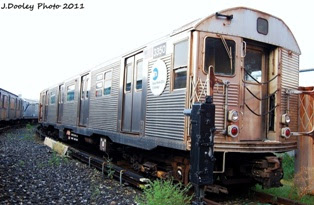
NYCTA cars added to list

It was pointed out to me that a pair of NYCTA type R32 subway cars, cars 3350 and 3351, have been missing from the PNAERC list even though they're part of the New York Transit Museum collection and stored with the NYCTA historic fleet at Coney Island Yard. Many thanks to Bill Wall for correcting my earlier erroneous information that these cars were owned by Railway Preservation Corporation!

As you may have guessed from the links, these cars have now been added to the list. They were built by Budd in 1964 and make up a married-pair set. They're known as "phase II" R32's following a major rebuild in the late 1980s. A bunch of R32's remained in service until about a year ago (later than expected due to issues with newly-delivered replacement cars) which is an awfully impressive service life. I'm not sure when 3350 and 3351 were assigned to the NYTM but Bill commented that it was some time after 2008, the year the other preserved set of R32's - identical pair 3352 and 3353 - were transferred to the museum collection.
And in unrelated news, I've been able to update a bit of information about a car at the Illinois Railway Museum. The only unidentified (as in, unknown fleet number) car in the IRM collection was a 1913 streetcar body from Tri City Railway & Light in Rock Island, IL. That's no longer the case and the car has been IDed as TCR&L 483, part of the 451-485 series constructed by American. It is the only known streetcar from Rock Island to survive. Its PNAERC record has been updated to add its fleet number. (The photo above, taken by yours truly in 2001 when this car was unloaded at IRM, is the only picture I've ever seen of it at IRM before it was hurriedly tarped.)

Wednesday, September 29, 2021

SLPS PCC returns home


Thanks to Randy Hicks for sending along this photo, taken a couple of days ago at the National Museum of Transportation in Kirkwood, MO. The photo doesn't reveal much by itself, other than that it's a PCC car under shrink wrap, but fortunately the museum volunteers he ran into filled him in. This is San Francisco Municipal Railway 1101, which was built in 1946 as St. Louis Public Service 1700, and it arrived in Kirkwood just in the last couple of weeks. The car was retired in the early 1980s along with the rest of the Muni PCC fleet and was stored in San Francisco until sold to the Tahoe Valley Lines PCC Railway in 1995. It's been for sale for something like 15 years and its owner finally found a buyer. (Another PCC recent left the Tahoe collection, leaving only three cars still owned by TVL: two Toronto 4400's and a bizarre Frankenstein-esque double-end PCC built by welding together the front halves of two normal San Francisco PCC's.)

NMOT's plans for their new PCC aren't certain. They just haven't decided exactly what they'll do. This is the second ex-SLPS, ex-Muni PCC they've acquired recently (following car 1140) and the third ex-SLPS, ex-Muni PCC on the property when you add in restored car 1743. It's unlikely that they'll retain all three cars long-term, but possible that they may retain two (1743 and one other, naturally) for historic purposes, in which case they'll have to decide whether to keep 1101 or 1140.

Wednesday, September 22, 2021

Illinois Terminal 535 removed from list

A few different Facebook pages have, over the past couple of days, featured some pretty jaw-dropping photos of Illinois Terminal 535 in Harristown, Illinois. This interurban car body was offered for sale by the property owner last year but found little interest from the preservation community given its atrocious condition. So one well-meaning preservationist stepped up and made an attempt to move the car to a location at the Bloomington, Illinois airport. Unable to raise enough money to properly transport the car intact, the owner evidently planned to cut it in half, move it in two sections, and then piece it back together. However the car's condition (and its weight, which for some reason exceeded the capacity of the forklifts rented for the job) made this impossible too.

After the car had been cut in half, the decision was made to instead disassemble it on-site with the goal of eventual reassembly/restoration. However at this point, I'm removing it from the PNAERC list. While the car's owner is obviously dedicated and well-meaning, it strikes me as unlikely that the car can be realistically reassembled in its original form. At best it would be something akin to a replica, though given the paucity of resources available for the project even that seems like a tall order. The owner has also professed an interest in making the car part of a diner, which may itself disqualify the thing from inclusion on the PNAERC list even if it is reconstructed.

A history of car 535 can be found at the link above. Depending on how you look at it, IT 535 was arguably one of three preserved interurban sleeping cars. The other two are complete and still in their sleeping car condition: IT 504 at IRM and Interstate Public Service 167 in Squamish, BC.

Tuesday, September 21, 2021

Singer 1 to Hoosier Heartland

Singer 1, the 1898-vintage 250-volt GE switching locomotive formerly at the Indiana Transportation Museum, has been donated by its owner to the Hoosier Heartland Trolley Company. The photo above, from the HHTC website page on the locomotive, shows it being moved into that organization's barn.

Singer 1 is an unusual little industrial critter. It was used at the Singer sewing machine factory in South Bend, Indiana until retirement in 1955, after which it was bought by Bob Selle. For a time it was stored at the Illinois Railway Museum's original site in North Chicago, then later it was stored for a time in Winthrop Harbor, Illinois. In 1971 it made its way to Noblesville, where it was displayed in good condition at the Indiana Museum of Transportation and Communication (later ITM) for many years. When ITM was evicted in 2018 the locomotive - still privately owned, never having been sold or transferred to ITM - was moved to Francesville, Indiana, where it has been stored since. It's the first complete piece of traction equipment owned by HHTC and also the group's first piece of freight equipment, joining a trio of interurban cars and a streetcar.