Friday, July 31, 2020

Yet more CLRV's

It's time yet again to add more CLRV's to the PNAERC list. We are now up to a total of 12 CLRV's and two articulated ALRV's on the list and that's not the end of it. There are at least two more of the former type that have been acquired by Halton County (they plan on scrapping two of their six for parts but it will take time to decide which two) and there are rumors that two or three additional cars were sold in a recent auction to buyers unknown. So let's get to it.

The first contender is car 4001, one of the original 1977 prototype cars built by SIG in Switzerland. This article from December was brought to my attention pointing out that the car is being preserved by TTC itself as part of the system's historic fleet. Also being preserved by TTC is car 4089, a standard production car dating to 1979 (or maybe 1980 - delivery took place over a couple of years) and built in Canada by Hawker-Siddeley. Both cars have now been added to the PNAERC list.

Then there's a pair of cars that have been acquired by the American Industrial Mining Company Museum, car 4024 and car 4170. What does the CLRV have to do with American mining? Glad you asked! Not a thing, as far as I can tell. However AIMCM seems to be very closely intertwined with Buckeye Lake Trolley, so it seems likely that these cars are intended to fit in more with the BLT collection than with the collection of mining equipment currently shown on the AIMCM website. Right now both cars are being stored at Halton County pending movement to the states, and I've made a notation that they're owned by BLT / AIMCM.

Speaking of Halton, in addition to the two AIMCM cars they're currently hosting, and in addition to the two cars they're currently hosting that are owned by Seashore, and in addition to the two mystery cars mentioned above potentially acquired as parts sources, they've also gotten a fourth CLRV for their historic collection. It's the car pictured (while still in service last year) at the top of this post: car 4178, which in September 2019 was hand-painted in a very colorful livery by local Toronto artists. TTC asked Halton if they would be interested in preserving this admittedly unique piece and they gamely agreed, so the car is now in Rockwood and also on the PNAERC list. Thanks to Gord McOuat for passing along this update.

And finally - for the CLRV category at least - comes this article about a young man who has purchased car 4187 and is moving it to his family's farm in rural Priceville, north/northwest of Toronto. Though I usually don't list cars like this until they've physically been moved, it sounded like this was a fait accompli and with private collections like this it's not terribly likely that updates will be communicated to the preservation community at large. EDIT: I was wrong - the update is here.

But wait, there's an encore. It appears that a second ALRV - the two-car articulated version of the CLRV - has indeed been preserved by TTC, joining CLRV's 4001 and 4089 in the system's historic collection. I believe that it is car 4207, built in 1988 and withdrawn from service in mid-2019. What with the pandemic scrambling things, neither the ALRV nor the TTC's preserved CLRV's seem to have made any public appearances, but at some point they will presumably emerge to join the system's Peter Witt and its two PCC cars in excursion service.

Friday, July 17, 2020

A move and an addition

The big news for today is that the National Capital Trolley Museum has acquired DC Transit 1470 from the Virginia Museum of Transportation in Roanoke. The news was report in a Facebook post (no log-in required). Car 1470 is a standard postwar Washington DC PCC car, built in 1945 by St. Louis Car Company, and bears some of the unique features of DC postwar cars such as air-electric brakes, taller-than-normal side windows, and a prewar style windshield. It also has an unusual automatic pole-lowering device. It joins the only other DC postwar car preserved domestically, car 1540, in the NCTM collection but it is in much better condition. Despite some 45 years of outdoor display in Roanoke, car 1470 was maintained in generally good condition from all appearances and may be a good candidate for restoration to operational condition. It was always a bit of an oddball display in Roanoke and it's great to see it back home at National Capital.

This is just the latest Washington DC car to be returned to home territory from initial preservation elsewhere. It follows prewar PCC car 1430, acquired from Rockhill in 1997; center-entrance car 650, brought home from Branford in 2002; and sweeper 09, repatriated from Rockhill in 2012. Other than PCC cars sold abroad or heavily rebuilt for service elsewhere, nearly every preserved car from Washington is now preserved in or near DC. EDIT: Many thanks to Wesley Paulson of NCTM for the photos of car 1470 now included in this post.


And on an unrelated topic, I've also added a new car to the list. It's not a newly-preserved car but it has just recently come across my radar as a significant piece of traction history. The car in question is Chicago Transit Authority S314, a work car preserved at the Fox River Trolley Museum. It has recently been cosmetically restored and is apparently in use. I'd seen it before but had been under the mistaken impression that it was essentially a piece of non-traction railroad work equipment. However it turns out that, while not self-propelled, it is fully 600v-powered (including a prominently mounted D3F pump) and has quite the illustrious traction heritage. It was built by Chicago City Railway as a cab-on-flat work car, later sold to the Calumet & South Chicago, and served the Chicago Surface Lines for decades.

Wednesday, July 8, 2020

Interurban sleeping car for sale

A post on Facebook here (no log-in required) reports that Illinois Terminal 535 is available for sale. The photo above is from that post. Car 535 is "sort-of" one of the last three interurban sleeping cars in existence. It was built by St Louis Car Company in 1911 as coach trailer 527 (it was part of the same series as, and was originally identical to, car 518 preserved at IRM). In 1930 the car was heavily rebuilt by the IT into a 9-bedroom sleeping car, renumbered 501, and given the name "Illinois." I'm not sure how much use it saw in sleeping car service given the onset of the Depression but in 1942 it was rebuilt again. This time its bedrooms were stripped out and it was turned back into a coach trailer numbered 535. It was sold into private ownership by the IT in 1966, went to the Monticello museum in 1972, and was then sold off by that museum in 1988. No other museum was interested so the body was sold to an individual who owned the IT depot in Harristown, Illinois. The car's body has been sitting next to the Harristown depot, more-or-less on the old interurban right-of-way, ever since. Its current owner is an individual who purchased the depot property a few years back, I believe.

So in a way - if considered on the merits of its 12-year bedroom car career - car 535 is quite historic. Only two other interurban sleeping cars still exist and both (IT 504 at IRM and IPS 167 in Squamish, BC) feature sections, not bedrooms. With some mental gymnastics you could also consider this the most modern interurban sleeper ever put into service, as I'm pretty sure nobody was building interurban sleeping cars after 1930. But while it's an historic car, it's also a pretty poor candidate for preservation. Unlike the other two extant sleepers, it's far from complete even as a coach, much less a sleeping car. It's a body and a pretty badly stripped one at that. Worse, its condition is wretched - from photos it looks like the body is wracked (racked?), the roof is in very poor shape, and the interior is a mess. It looks like it would be a project just to move the car at all without it collapsing. So unfortunately it seems like a bit of a stretch that it will find a new home and long-term preservation. But I suppose time will tell.

Tuesday, June 30, 2020

PCC cars for sale

The Seashore Trolley Museum has announced on their website that they are putting a total of nine PCC cars up for sale (along with some buses). The cars are divided into two categories: single-ended cars built for Boston, of which there are three, and double-ended cars built for Dallas and later sold to Boston, of which there are six.

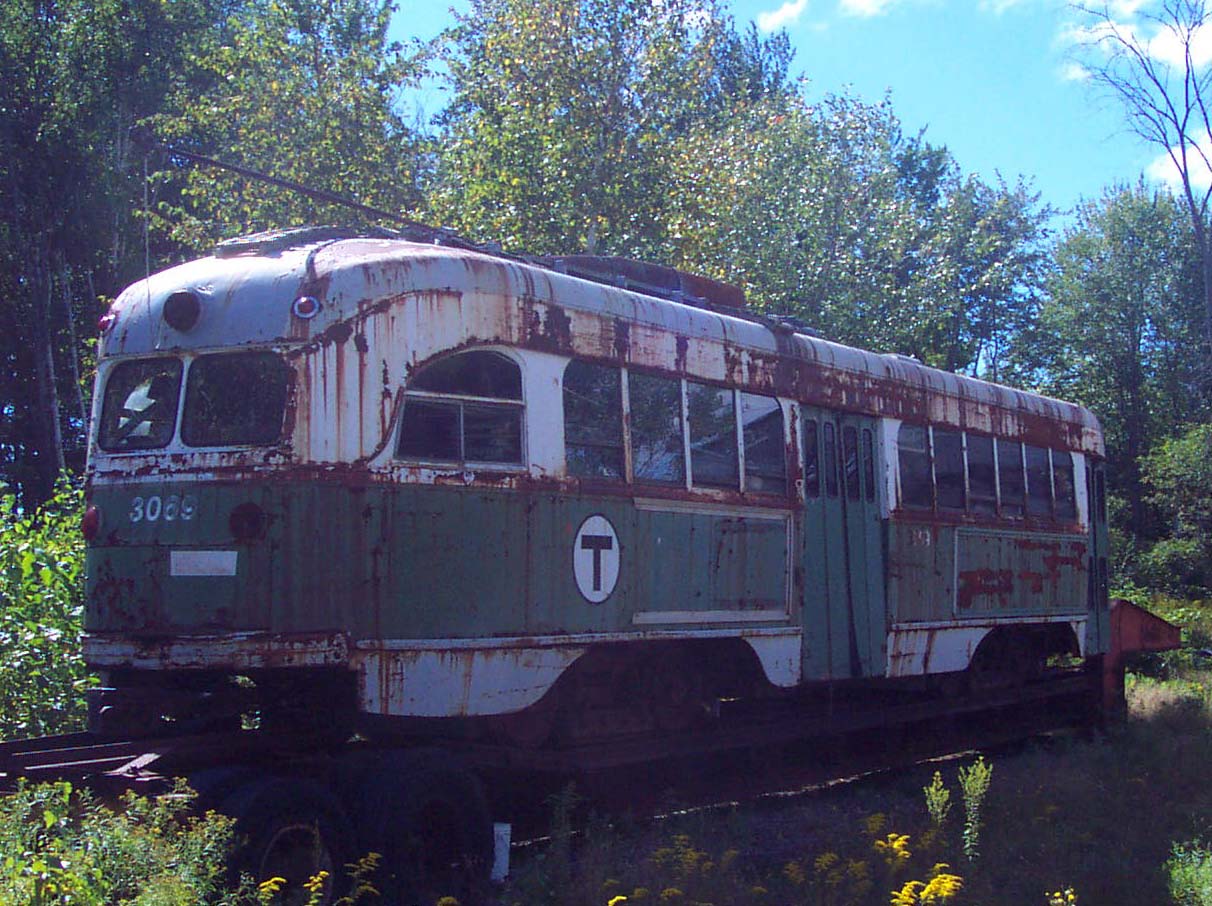
The single-ended cars are MBTA 3037, MBTA 3069, and MBTA 3174. All three were already listed on the PNAERC roster as "not accessioned" thus it is no shock that they're now being formally offered for sale. Cars 3037 and 3069 (the latter shown above in a photo from hopetunnel.org) were both built by Pullman-Standard in 1944 and are duplicates of car 3127, which is part of Seashore's historic collection. Car 3037 has been tarped in recent years while car 3069 has been displayed atop the "highway monster," Seashore's streetcar-hauling tractor-trailer rig, as an exhibit piece. Car 3174 was built by Pullman-Standard in 1945 and is duplicated by car 3221 in the Seashore collection It too has been tarped in recent years if I'm not mistaken. Cars 3069 and 3174 have been at Seashore for 35 years now while 3037 arrived later and has been in Kennebunkport since 1994.

And then there are six Dallas double-ended PCC cars, all of them built by Pullman-Standard in 1945. Four of them - cars 3328, 3331, 3338, and 3344 - were already listed on the roster as being for sale. These are cars that were acquired by Seashore in 1985 (except for 3338, which was acquired in 1994 from a short-lived preservation group) for the purpose of resale. They've been shopped around to various transit operators and heritage lines on and off for a few decades now but with no takers yet.

The other two cars are 3327 and 3343, both of which were converted into work cars and arrived at Seashore in 1999. These two cars have not been listed as deaccessioned, so the decision to sell them is new information. Both had large equipment doors cut into the middle of the car body, not to mention interior modification, so they'd need backdating work to turn them back into passenger cars.

As with the single-ended cars, Seashore has examples of Dallas double-enders that they are keeping in their historic collection, both in passenger (Dallas 608 - later MBTA 3342 - in original colors and car 3340 in Boston livery) and in work car (line car 3332) configuration. Thus, this proposed thinning of the collection won't remove anything particularly unique from the Seashore fleet.

Monday, June 29, 2020

Well that's embarrassing

Back in March, I got an email from Joe Sharretts that pointed out a mistake on the PNAERC roster. It took me a little while to get to the bottom of it (many thanks to Joel Salomon and Charles High for providing more information) but over the weekend they confirmed that my listings for Red Arrow cars at the Middletown & Hummelstown have been incorrect for years. And it's not a minor thing either: the M&H has two "80-series" Red Arrow cars, but my roster has long listed three of them there. One of these three cars on the list hasn't actually existed since it was scrapped in 1982.

So what in the world happened? Until now the three 80-series cars on my list were car 77, car 83, and car 86. There's no question around car 77; it was apparently sold to the M&H in 1982 and in recent years has had one end on jack stands with a truck pulled out (photo here). The issue comes with cars 83 and 86. Apparently, when the M&H decided to buy Red Arrow cars, they purchased 77 and 86. However at the last minute someone - whether at the M&H or at SEPTA - decided that car 86 had some damage and that car 83, which I guess hadn't been sold, would be a better car to get. So the numbers were swapped. Car 83 was hastily painted up as car 86, while car 86 briefly acquired the number 83 before it was scrapped. At least, from what I'm told that's what's going on... hopefully I'm not getting this backwards!

So car 83 is the second 80-series car at the M&H; it's pictured at the top of this post in a Connor Frasier photo from here and if you look closely you can see that its fleet number appears to have been altered at some point. In retrospect that's part of what caused the confusion: depending on which side or end of the car you were looking at, its number either looked more like "83" or more like "86" so I thought that I was just seeing photos of different cars. Oops. Well, at least the mistake is corrected now. We regret the error.

Wednesday, June 24, 2020

Trolleyville alumni newsletter

Following the return of Shaker Heights 18 to operation at IRM, the good news for Trolleyville alumni continues to roll in. This past weekend, Iowa Southern Utilities 1 was made operational at the Connecticut Trolley Museum for the first time since it left Ohio. The above photo was published on their Facebook page (no log-in required). The car, a single-truck line car rebuilt from a streetcar dating all the way back to 1892, required some wiring and roof work to be made runnable.

With recent progress on ex-Trolleyville cars (a third Trolleyville car is also likely to run in the coming months for the first time since it left Ohio), and given that it's now been just over a decade since the Great Dispersal of the Trolleyville collection that was coordinated by Branford's Bill Wall, I figured it was time for an alumni report. What ended up happening to all of the equipment from Trolleyville?

Connecticut Trolley Museum
ISU 1 - this line car has been stored under cover since 2010 and has just been made operational
CA&S 101 - stored indoors since 2010, it was vandalized by copper thieves in 2012 and has not run at CTM
AE&C 303 - stored indoors and operated on occasion, though its large size makes it unwieldy for regular use at CTM

Fort Smith Trolley Museum
CTUSU 9 - the more complete of two Veracruz open cars owned by FSTM, this car is said to be undergoing restoration work

Fox River Trolley Museum
SHRT 304 - stored indoors in good condition and operated on a regular basis
CA&E 458 - currently stored inside and the subject of a major re-roofing project

Illinois Railway Museum
SHRT 18 - the last car to leave Cleveland (in 2013), stored tarped until 2016, just made operational
CTUSU 19 - in good condition and operated on a regular basis
CA&E 36 - restored to operation mid-2010s, operated on a regular basis
GCRTA 63 - stored indoors since 2016, made operational but unrestored and not currently in use
CA&E 319 - restored early-2010s, operated on a regular basis
CA&E 409 - in good condition and operated on a regular basis
CA&E 451 - undergoing restoration work to as-built condition, work updates here
CA&E 453 - the only extant Trolleyville car to change hands post-2010; at Electric City Trolley Museum 2010-2019, moved to IRM in 2019, now stored indoors awaiting restoration
CA&E 460 - in good condition and operated on a regular basis

National Capital Trolley Museum
Blackpool 606 - British "Boat Car" not on the PNAERC roster, in good condition and operable
TTC 4602 - in good condition and operated on a regular basis

New York Museum of Transportation
CTS 021 - stored indoors in good condition and in use

Northern Ohio Railway Museum
GCRTA 172 - stored outdoors in fair condition
SHRT 303 - undergoing restoration including heavy work on the end of the car
CRC 1225 - stored indoors in good condition
SHRT OX - stored indoors in good condition

Pennsylvania Trolley Museum
CSR 2227 - restored to operation early-2010s, operated on a regular basis
PRys 4145 - left Cleveland in mid-2009 before the rest of the collection was dispersed; in good condition and operated on a regular basis
TR&L "Toledo" - stored indoors in good condition, some restoration work has been done

Seashore Trolley Museum
GCRTA 113 - stored outside since 2010 in moderate condition
CRC 2365 - tarped and in outside storage since 2010

Cars lost since 2010
SHRT 71 - Pullman PCC car in poor condition, sold to Electric City 2009, scrapped for parts at NORM in 2010
SHRT 76 - Pullman PCC car in poor condition, sold to Electric City 2009, scrapped for parts at NORM in 2010
CA&S 100 - Iowa box motor in poor condition, was sold to PTM to strip for parts. Some components are slated to go to the parlor car "Toledo."
MBTA 3334 - this Dallas double-end PCC was stored at IRM by owner McKinney Avenue from 2009 until 2015, when it was moved to Dallas. MATA ended up scrapping it in 2017.

Overall the Trolleyville collection has fared extremely well, which is fitting given the good condition of most of the pieces when they were in North Olmsted and Cleveland. Of the 31 electric cars listed here, only four were scrapped. All but three of the remaining cars are currently stored under cover and 14, or more than half of the extant cars, are currently operational with a further four (at least) the subject of active restoration work.

Corrections are welcomed. This doesn't count electric cars that left Trolleyville before the Great Dispersal like AE&FRE 306 at IRM or GCRTA 163 at ORM nor does it count a couple of steam railroad cabooses that found new homes in 2010.

Thursday, June 18, 2020

A couple of updates

Here are a couple of updates of news items that have popped up in recent days. First, as reported on our sister blog Hicks Car Works, Shaker Heights Rapid Transit 18 (shown above) is now operational at the Illinois Railway Museum. Restoration work on the car is ongoing and repainting into 1940s "bankers colors" with correct lettering is planned. This was the last Trolleyville car to leave Cleveland. After the Trolleyville collection was dispersed in 2010, car 18 was stored on the Cleveland RTA for another three years in the hopes that it would end up displayed in the city. That didn't happen, though, and it was acquired by IRM in 2013. It's now one of three operating Shaker Heights center-door cars, joining car 12 at NORM and car 1227 at Seashore.

And in other news, El Paso PCC car 1510 is evidently for sale according to this post on Facebook (no log-in required). The car, built in 1937 as San Diego Electric Railway 517, was sold into private ownership in 1986 and has served as a couple of different retail shops in its longtime home at the corner of 3rd & Mesa in El Paso. While its interior has obviously been stripped out, it's likely that the car's structure is relatively sound, though it's hard to say for sure whether it's had any extra holes cut into it. From appearances it also retains its trucks and, most likely, at least some of its electrical equipment.