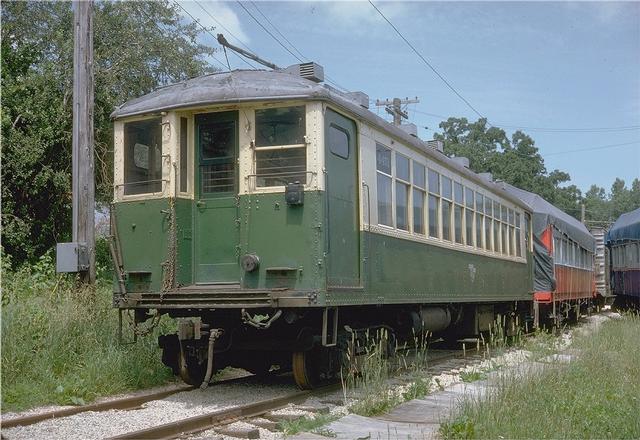
Showing posts with label Fox River Trolley Museum. Show all posts

Tuesday, May 12, 2026

SEPTA Spam Cans to South Elgin

A post today on Facebook revealed that SEPTA 476 and 477, the pair of ex-Chicago Transit Authority 6000-series 'L' cars at the Middletown & Hummelstown, have left the M&H and are headed to the Fox River Trolley Museum.
CTA 6000s are not exactly an endangered species. Besides this set, another seven married pairs (plus half of another pair) are known to exist, and that's not counting another five pairs in Windber that may have already been scrapped. There are also another nine single-unit variants still around, three of which are at FRTM. But cars 476-477 are slightly interesting. Built by St. Louis Car Company in 1951 as CTA 6069-6070, they are the oldest 6000s still in existence, at least going by car number. They're part of the first 200 cars of this type ordered by the CTA - a subtype nicknamed "flat-door" cars for their most obvious distinguishing feature - so these cars weren't built using components from scrapped PCC streetcars like the later 6000s were.

This pair was part of a group of flat-door 6000s sold in 1987 to SEPTA, which was experiencing a critical car shortage on the ex-Red Arrow third-rail line to Norristown due to wrecks and reliability problems with the 1920s- and 1930s-vintage Strafford cars and Bullet cars. Though far from ideal for service on the Norristown line, the 6000s saw use until the new N-5* cars were delivered in the early 1990s. This pair was bought by the M&H in 1994, apparently with the idea of scrapping the bodies and placing the trucks under the SEPTA PCC streetcars that arrived at the same time as a way of standard-gauging them, but that never happened. Cars 476 and 477 sat in the yard in Middletown, usually separated from each other, for a bit over 30 years.

For FRTM, this is a bit of an unexpected acquisition. Nine years ago they got rid of CTA 6101-6102, a pair from this same order that had been backdated by the CTA prior to retirement. The museum has also been focusing more on extending its barn than on growing its collection; they've scrapped or sold five cars in the last five or six years, by my count, and I believe 476-477 are the first electric cars they've acquired since the Trolleyville dispersal back in 2010 (correction: thanks to Bill Wall, who reminds me that just recently they received the Rio open car that had been owned by Wendell Dillinger!). Their roster on PNAERC now stands at 20 cars, with "spam cans" comprising a full 25% of the total. FRTM now joins IRM, Seashore, Craggy Mountain Line, and the CTA itself in the ranks of married-pair 6000 owners.

For its part, the M&H is continuing to pare down its traction collection. Other than Lackawanna MU cars, and the Rio open car they plan to keep that isn't on the PNAERC roster, they're now down to just five pieces: Red Arrow 77, supposedly intended to stay in Middletown; SEPTA 2104; KCPS 2; BRT 4550; and SBK 9425.

*Thanks to Bill Wulfert for the correction

Tuesday, February 10, 2026

PCC Updates from the Fox River

There are a couple of PCC-related updates from the Fox River Trolley Museum in Illinois. The first is that San Francisco Municipal Railway 1030, the 1951 PCC shown in the above photo taken on Saturday, has been scrapped along with a diesel. This car has been stored out of service for decades and was offered to other organizations more than a year ago. Given its condition, there were no takers. This car was far from unique; eight other cars from this series are preserved intact, and both the first and last members of the class have been beautifully restored by their respective owners. FRTM now has 18 cars included on the PNAERC roster.
But wait, there's more PCC news from FRTM. The above PCC 'L' car, Chicago Transit Authority 45, was repainted late last year in its 1970s-era "mint green and alpine white" livery. It has worn these colors for roughly 20 years, since its days at the East Troy Electric Railroad, and in recent years the paint had faded. When ETER conducted a major culling of its own collection in 2009-2010, the only one of its three CTA "singles" to be sold rather than scrapped was this one. It's been in regular use at FRTM ever since. (The above photo is from the FRTM Facebook page; thanks to Anderson Pries for emailing me about car 45's repainting and for sending me photos which I regrettably managed to lose.)

Thursday, October 2, 2025

WMATA 2000s Added to the List

The Washington Metropolitan Area Transit Authority announced today that they'd shipped the last of their 2000-series subway cars off to scrap - the last, that is, except for the pair they've set aside for preservation. Those cars weren't on the PNAERC list until now, but I've just added WMATA 2000 and 2001 to the database.

These two cars were built by Breda in 1981 and in terms of overall construction, they're extremely similar to the other WMATA cars that entered preservation a few years back. They were overhauled around 2002 or so and at that time they acquired upgraded inverter control and AC traction motors. This seems to have made them more reliable than the older 1000s, which acquired earlier-generation AC motors in the mid-1990s; the 4000s, which were never upgraded with AC motors; or even the 5000s, which were built in 2001 with AC motors. (The 3000s, built in the late 1980s and upgraded with AC motors around 2009, are still in service.) The last 2000-series cars were retired just about a year ago, in October 2024, and cars 2000-2001 were in the ceremonial last-day-of-service train (pictured above in a photo from here). As far as I know, cars 2000-2001 are stored in Greenbelt Yard along with the other six cars in the WMATA historic fleet.

And in other positive news, thanks to Anderson Pries for sending the above photo taken last weekend of Chicago Aurora & Elgin 316 at the Fox River Trolley Museum. The occasion was the dedication of this 1913 Jewett-built interurban car following a major restoration effort, and sister car 20 - the oldest operating interurban car in the country, but mostly out of service pending wheel work - came out for the first time in a few years for the occasion as well. Car 316's status has been updated to reflect that it is no longer under restoration, but has joined the FRTM operating fleet.

Saturday, November 9, 2024

Muni PCC Available

The Fox River Trolley Museum announced today on Facebook that they are deaccessing two pieces of equipment and making them available to other museums. One of the two pieces is on the PNAERC list: San Francisco Municipal Railway 1030, a "Baby Ten" PCC built by St. Louis Car Company in 1951 as part of the last domestic order for PCC cars ever built. The car came to FRTM in 1983, after it was retired, and ran a few times but was quickly stored because its single-ended setup doesn't work well for the museum's operations. The car is complete, but its poor condition after four decades of outdoor storage may make it challenging to find a taker. It is one of nine cars of this series still in existence (not counting the infamous double-ended Franken-PCC). Of those nine, two have been fully restored: car 1016, beautifully restored to as-built condition at Rio Vista, and car 1040, fully restored to original livery but with some modern accoutrements to permit regular operation on home turf on Muni's F Line. The remaining six cars are all owned by Muni and are in storage; given that they recently scrapped an additional three of this type, it seems unlikely they'd want this one.

Though it's not on the PNAERC list, the other car deaccessed by FRTM is likely more historic than car 1030 by virtue of being unique. It's a flat car built for Chicago North Shore & Milwaukee piggyback service. There are three CNS&M piggyback flats still in existence, but this is the only one from the railroad's second order for longer 60' cars; the other two, one at the Illinois Railway Museum and one at the National Museum of Transportation, are both 40' cars.

Friday, July 17, 2020

A move and an addition

The big news for today is that the National Capital Trolley Museum has acquired DC Transit 1470 from the Virginia Museum of Transportation in Roanoke. The news was report in a Facebook post (no log-in required). Car 1470 is a standard postwar Washington DC PCC car, built in 1945 by St. Louis Car Company, and bears some of the unique features of DC postwar cars such as air-electric brakes, taller-than-normal side windows, and a prewar style windshield. It also has an unusual automatic pole-lowering device. It joins the only other DC postwar car preserved domestically, car 1540, in the NCTM collection but it is in much better condition. Despite some 45 years of outdoor display in Roanoke, car 1470 was maintained in generally good condition from all appearances and may be a good candidate for restoration to operational condition. It was always a bit of an oddball display in Roanoke and it's great to see it back home at National Capital.

This is just the latest Washington DC car to be returned to home territory from initial preservation elsewhere. It follows prewar PCC car 1430, acquired from Rockhill in 1997; center-entrance car 650, brought home from Branford in 2002; and sweeper 09, repatriated from Rockhill in 2012. Other than PCC cars sold abroad or heavily rebuilt for service elsewhere, nearly every preserved car from Washington is now preserved in or near DC. EDIT: Many thanks to Wesley Paulson of NCTM for the photos of car 1470 now included in this post.


And on an unrelated topic, I've also added a new car to the list. It's not a newly-preserved car but it has just recently come across my radar as a significant piece of traction history. The car in question is Chicago Transit Authority S314, a work car preserved at the Fox River Trolley Museum. It has recently been cosmetically restored and is apparently in use. I'd seen it before but had been under the mistaken impression that it was essentially a piece of non-traction railroad work equipment. However it turns out that, while not self-propelled, it is fully 600v-powered (including a prominently mounted D3F pump) and has quite the illustrious traction heritage. It was built by Chicago City Railway as a cab-on-flat work car, later sold to the Calumet & South Chicago, and served the Chicago Surface Lines for decades.

Sunday, May 3, 2020

South Shore departs Fox River

Thanks to Bob Harris, who has alerted me that both of the Fox River Trolley Museum's South Shore Line interurban cars have departed South Elgin for good. The photo above, from Bob, shows CSS&SB 7 at its new home on private property in Michigan City, Indiana where it has just arrived.

Car 7 - shown above in a photo taken at FRTM in 2014 - is a standard un-lengthened South Shore car built by Pullman in 1926 as part of the railroad's initial order for steel coaches. It was part of the collection of South Shore cars acquired in 1984 by the National Park Service and didn't show up at FRTM until 1988. At that point it was on "permanent loan" but in 2010 the NPS divested itself of its far-flung collection of South Shore cars and at that time it was formally conveyed to FRTM. During its entire time in South Elgin it's been a static display piece, far heavier than the museum's line was designed for, and its condition has slowly deteriorated.
So that's the first of the two South Shore cars to have left FRTM. The second is the one above, South Shore car 14, shown in another photo from 2014. Car 14 was also built in 1926 as part of the railroad's first order for steel cars but it was one of the cars stretched in the 1940s by the railroad's shops to an overall length of 77'6" (compared with its 60' original length). This car was acquired by FRTM straight from the South Shore in 1984 so it's been a static display piece at South Elgin for more than 35 years. The years have not been kind to this car and its condition had deteriorated badly. It was scrapped, with its parts going towards car 7 and other preserved South Shore cars in Indiana. It has been removed from the PNAERC list.

By my estimation, Fox River is to be commended for getting rid of these two cars, as they had become little more than eyesores. The museum's public presentation can only benefit. There is no loss from an historic standpoint as there are still 28 extant South Shore coaches including 11 from this exact order. The new owner of car 7 is also to be commended for taking on a significant, though certainly feasible, project.

Monday, May 7, 2018

CTA car at Fox River under restoration

Chicago Transit Authority 4451 at the Fox River Trolley Museum is now in the midst of a major roof rebuilding project, according to a recent post on the FRTM website. For many years this car was one of the regular operating cars at FRTM but it was retired around 2016 due to general deterioration. It is now having a new roof put on, which when complete presumably will allow the car to be placed back into public operation. Its status on the PNAERC list has been updated to "undergoing restoration."

Judging from photos, 4451 and CA&E 458 - acquired eight years ago from Trolleyville - are now stored inside the museum's barn. It appears they have taken the indoor spots of CTA 4288 and CA&E 317 respectively, two cars which have been out of service for at least twenty years.

Wednesday, August 9, 2017

CTA 6000s return to Chicago

It appears that today was the day that CTA 6101-6102, the preserved set of 6000-series "spam cans" at the Fox River Trolley Museum, were loaded and transported back home to the Chicago Transit Authority. There they join a pair of 4000s and a handful of buses in the CTA's new "historic collection," a project headed up by Graham Garfield of the CTA. The plan, supposedly, is that Skokie Shops will rebuild (and presumably repaint) the 6101-6102 so that they can be operated for special events, similar to how the 4000s are used. The cars had been sold to FRTM in 1994 with the provision that they could not be operated carrying passengers, and as such had always been on static display at South Elgin. Back with the CTA, they will presumably see use on their home rails and may at some point be joined by more 6000s. Only time will tell on that point.