SMR 200 is one of just five Ottawa-built snow sweepers in preservation and is (now) the only one in operational condition. There are some intriguing "missing links" in this car's history, including that it was built in 1907 but didn't arrive in Saskatoon until 1913, with its whereabouts in the interim unknown. I'm also not sure about its history between the Saskatoon system quitting in 1951 and ERRS acquiring it in 1986.
News and Updates to the Preserved North American Electric Railway Cars (PNAERC) List
Showing posts with label Edmonton Radial Railway Society. Show all posts
Monday, September 9, 2024
Saskatoon Sweeper Update
Many thanks to Cliff Humphrey of the Edmonton Radial Railway Society, who has sent along the following photo and update of restoration work on Saskatoon Municipal Railway 200:This 1906 Ottawa Car Company sweeper is now operable and can be used to sweep snow. Hopefully, some 'testing' will be done this winter! The cable-lifted work platform and wing plow assemblies are still being worked on, so the car is not technically complete yet. Sask 200 has already been driven around Fort Edmonton in a few tests and display runs; it will officially debut alongside Regina 42 in 2025. The big item on this car is the brushes; the chain-driven mechanism was a difficult system to rebuild, especially using a cast steel chain of uncertain origin (we know it came from 200, but whether it's original from 1906 or a later component is unclear). The brush drive system took a lot of staged testing to ensure it was safe to operate, and a couple months of concerted effort to rebuild the original brush boards with new rattan. The brushes are incredibly loud while operating, and we aren't sure if we'll be able to operate it regularly on our Fort Edmonton track due to how close the buildings (and their windows!) are to our track. Although double-ended, Sask 200 can't run on our High Level Bridge line due to only having hand brakes. ERRS isn't sure how we'll make use of it, but even having a car like this in operable condition for static display will be great for us.
Friday, April 12, 2019
Housekeeping
As usual, I've been making changes to the PNAERC roster here and there as I go along. I'm constantly correcting date here or adding some bit of technical information there. Recently I was able to pick up a very nice book on the Edmonton Radial Railway from Keven Farrell of the Seashore Trolley Museum. This permitted me to fill in a lot of electrical, mechanical, and dimensional data for the ten preserved cars from that system. These cars all reside at the Edmonton Radial Railway Society in their hometown and make up an eclectic mix. Car 42, shown in the above photo, is one of three survivors built by St. Louis in 1912 with the relatively rare turtleback roof design and was completely restored by ERRS from chicken coop condition, complete with St. Louis 47 trucks cast and assembled by the Society.
Then at the opposite end of the continent there's the North Jersey Electric Railway Historical Society. Olin Anderson pointed out that cars 5221 and 5223, both Newark subway work cars in their later years, were listed on PNAERC under United Railroad Historical Society ownership but for consistency (given their location) are probably better off listed under NJERHS ownership. So I've made that change. I'm still seeking more historical information on both of these distinctive and mechanically complete, but enigmatic, cars. UPDATE: Bill Wall has kindly provided some additional information on 5221 and 5223, not only filling in some motor/truck/control details but confirming that 5223 was indeed rebuilt by PSCT in the 1950s from a standard passenger car numbered 2683. Apparently NJERHS has plans to eventually rebuild it in passenger car form, which would make it identical to car 2651, their PSCT car from the same series.
And finally, thanks to Joel Salomon who has confirmed that Philadelphia work motor W-54, which had until recently been listed on PNAERC (but as "situation unknown"), was indeed scrapped a number of years ago while still at SEPTA. It has been removed from the list.
Friday, August 24, 2018
Regina streetcar added to the list
While perusing the website of the Edmonton Radial Railway Society, I came across a car that wasn't on my list. That's because they acquired it in 2013, which by my standards is fairly recently I suppose, and word of it just hadn't made it this far. The car is Regina Municipal Railway 8, a single-truck wood car built by Preston in 1913. It's a body but is said by the ERRS website to be in reasonably good condition.
I don't have much information on this car in the way of mechanical components so I guess some research is in order. From the photo, it appears to be a fairly standard Preston single-trucker, very similar to Toronto Suburban 24 in Edmonton, Lethbridge Municipal Railway 8 in Lethbridge, or Saskatoon Municipal Railway 40 in Saskatoon.
Tuesday, September 19, 2017
A selection of Cleveland streetcars
Looking into Cleveland Railway 0140, the single-trucker preserved at the Henry Ford Museum, got me thinking about preserved streetcars from Cleveland. There aren't very many streetcars from Cleveland still around, but the ones that are still around actually offer a reasonable cross-section of the city's electric railway history. Unlike, say, Los Angeles or Chicago, though, where the majority of the city's preserved streetcars are in one place, the extant Cleveland cars are scattered across the continent.
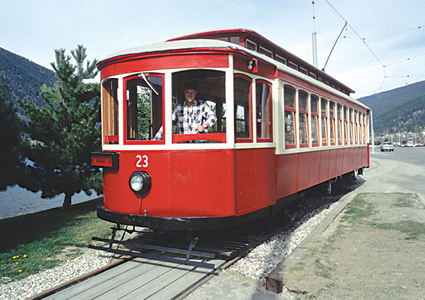
The oldest is car 0140, a Brill product fairly typical of 1890s single-truckers. It's preserved in Michigan, only a few hours from its home. The second oldest is a rather significant car: Municipal Traction 3334, later Cleveland Railway 934 and eventually Nelson Electric Tramway 23. Its design isn't particularly significant, as it's basically a catalog model Brill semi-convertible (albeit built by Stephenson, by then a Brill subsidiary, and modified several times during its life). But it was built for Municipal Traction, the "three cent line" championed by Cleveland mayor Tom Johnson in his populist fight against Cleveland Railway. An extensive account of this fight can be found here. Municipal Traction used a car numbered 3333 for promotional purposes to highlight its three cent fare and this car was numbered just one higher. Eventually it found its way out to western Canada, where it ran in Nelson and eventually became a grounded body. The Nelson Electric Tramway Society has restored it to operation on their riverfront streetcar line.
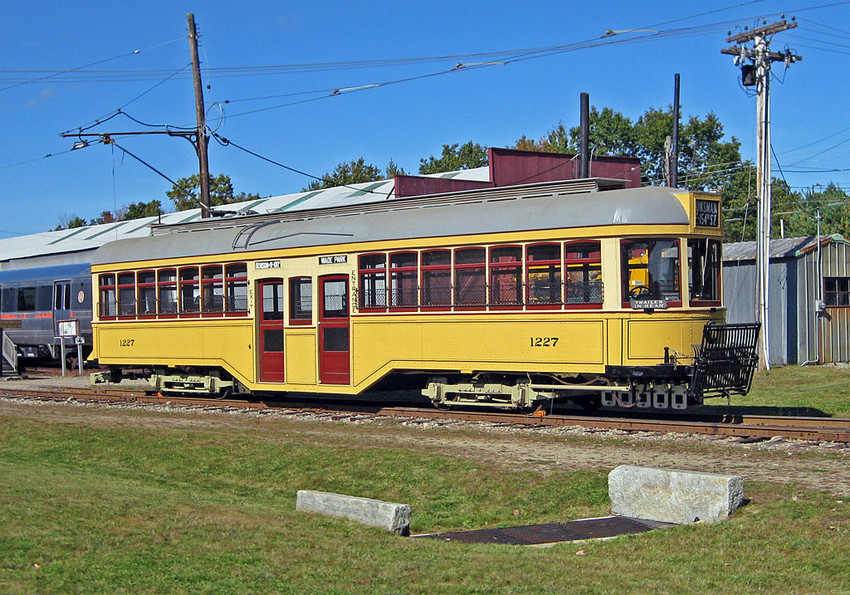
The result of Mayor Johnson's campaign for enforced low fares in Cleveland was that the street railway sought to lower its costs on a per-rider basis. This meant bigger cars and motor-trailer trains to reduce manpower requirements. Thus the next-oldest Cleveland cars are the big center-door cars built by Kuhlman in 1914, of which the best example is likely car 1227, restored to original condition by the Seashore Trolley Museum at great expense. It is likely to eventually be paired with matching trailer 2365 from 1917, currently intact but awaiting restoration work. These cars are large for streetcars, about 50' long each, and seat about 60 people (compared with a seating capacity of just 44 for the standard Chicago car around 1910, the "Old Pullman"). Thus in Cleveland in 1920 you could transport 120 seated passengers with a crew of three, whereas in Chicago you'd need twice as many employees and three streetcars to move that many seats.
The next step in Cleveland streetcar progression was the Peter Witt. None of the city's earliest 1915-built examples survive, nor do the later 1920s Kuhlman cars that ran well into the 1950s. But two examples survive that were actually diverted to Cleveland in 1918 from an order placed by the streetcar company in Rochester, New York. Cleveland Railway 1079 ran in Cleveland for only five years until it was sold for use in London, Ontario in 1923; later it went to Saskatoon, Saskatchewan, where it was retired in 1951 and is preserved (apparently in complete condition, though I've never seen a photo of this car taken in recent decades) at the Edmonton Radial Railway Society.
It's unfortunate that none of the more modern city cars that ran in Cleveland were preserved, particularly the newer Peter Witts and the famous articulated cars, until the PCC era is reached, by which time Cleveland Railway had become Cleveland Transit System. One PCC car built for CTS by Pullman in 1946, car 4223, is being fully restored by the Illinois Railway Museum. The most interesting aspect of this car's design is arguably that it's thought likely that it belongs to a series of cars originally ordered for Baltimore, but cancelled following takeover of that city's streetcar lines by Baltimore Transit. Certain obscure design features in the 1946 Cleveland cars suggest specifications issued by Baltimore, but documentation on this is tough to come by. Regardless, the PCC cars were the last city cars built for Cleveland and end the story begun by cars like 0140 in Dearborn.
Subscribe to:
Posts (Atom)