Showing posts with label Illinois Railway Museum. Show all posts

Monday, May 18, 2026

The IRM 'L' Car Fleet Grows

A pair of new - and in this case, "new" means "42-year-old" - rapid transit cars arrived at the Illinois Railway Museum on Friday, fresh from the Chicago Transit Authority. CTA cars 2871 and 2872, a married-pair set, are 2600-series cars built in 1984 by Budd. This was one of the last orders for railway cars built by Budd, and in fact the last cars of this order were also the last rapid transit cars ever completed by the Philadelphia car builder. This particular pair went into service a couple of years before that and were just retired, making them the newest CTA cars in preservation. Many cars of this series are still in service, and with deliveries of new 7000-series cars having slowed to a trickle, some of the remaining 2600s may be in revenue service for a while yet.

With these new arrivals, the IRM collection listed on PNAERC has grown to 147 cars - second only to Seashore in quantity - of which 42 are rapid transit cars. Cars 2871-2872 are the first electric cars acquired by IRM in six and a half years, which I believe is the longest such "drought" in the museum's history. On average, IRM has acquired two electric cars per year, every year, for its entire 73-years history. (And to be fair, the museum has been adding railroad and rubber-tired equipment to its fleet at a steady clip during these last few years.) The PNAERC list overall now stands at 2,089 pieces.

Thursday, May 2, 2024

Illinois Terminal Line Car Runs

As outlined on our sister Hicks Car Works blog here and here, the Illinois Railway Museum has gotten its Illinois Terminal line car, IT 1702, operating for the first time since it left the IT in 1958. Museum volunteers began working on restoring the car's body in 2021, work that was completed in early 2024, and the car's control system was rebuilt over the last five months or so to get it operating for an event this past weekend.
The car's status on PNAERC has been updated from "undergoing restoration" to "operated occasionally." Another update at IRM has been made to IT 415, the first car ever to run at the museum back in 1966. This lightweight interurban was taken out of service in 2020 for exterior restoration, and that work was completed within the past couple of weeks as well. Its status has been updated to "operated often," as it has long been a mainstay of public operations at IRM and is expected to return to a prominent role.

Sunday, January 22, 2023

North Shore 354 returned to service

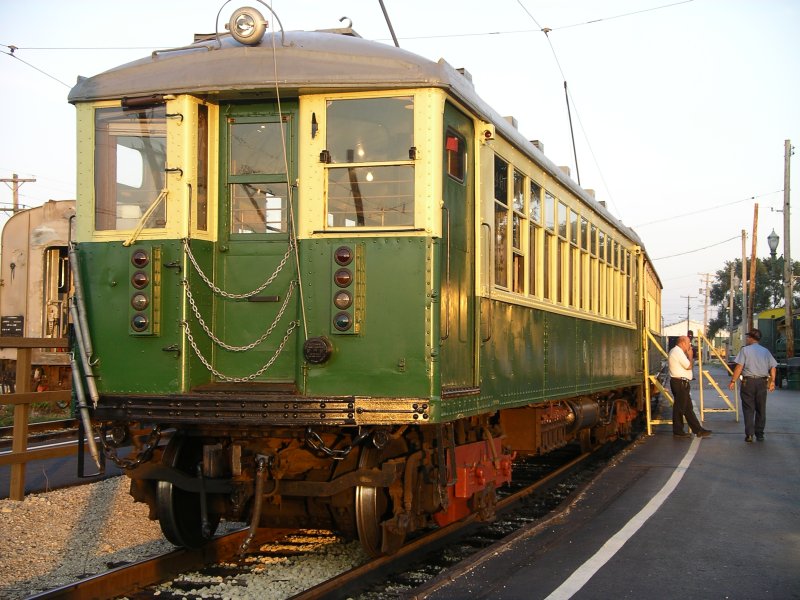
January 21, 2023, was the 60th anniversary of the end of the North Shore Line, and the Illinois Railway Museum held a large event to commemorate the date. The museum ran its five operational NSL interurban cars, but also ran two cars that for some years had been unserviceable. The first was streetcar C&ME 354, shown above, which was returned to service by the museum after some 20 years of disuse. The second was box motor (or "MD car" in North Shore parlance) CNS&M 229, which was put back into service after some eight years of storage. Both cars have had their condition/status updated in PNAERC.

Friday, October 8, 2021

NYCTA cars added to list

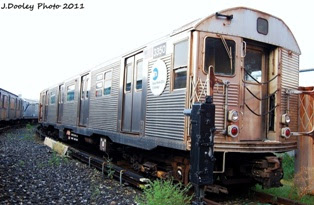
It was pointed out to me that a pair of NYCTA type R32 subway cars, cars 3350 and 3351, have been missing from the PNAERC list even though they're part of the New York Transit Museum collection and stored with the NYCTA historic fleet at Coney Island Yard. Many thanks to Bill Wall for correcting my earlier erroneous information that these cars were owned by Railway Preservation Corporation!

As you may have guessed from the links, these cars have now been added to the list. They were built by Budd in 1964 and make up a married-pair set. They're known as "phase II" R32's following a major rebuild in the late 1980s. A bunch of R32's remained in service until about a year ago (later than expected due to issues with newly-delivered replacement cars) which is an awfully impressive service life. I'm not sure when 3350 and 3351 were assigned to the NYTM but Bill commented that it was some time after 2008, the year the other preserved set of R32's - identical pair 3352 and 3353 - were transferred to the museum collection.
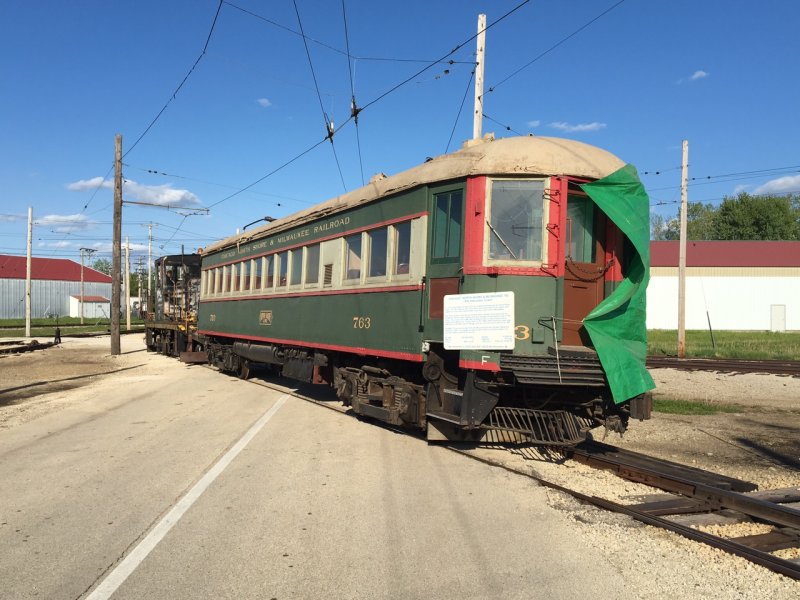
And in unrelated news, I've been able to update a bit of information about a car at the Illinois Railway Museum. The only unidentified (as in, unknown fleet number) car in the IRM collection was a 1913 streetcar body from Tri City Railway & Light in Rock Island, IL. That's no longer the case and the car has been IDed as TCR&L 483, part of the 451-485 series constructed by American. It is the only known streetcar from Rock Island to survive. Its PNAERC record has been updated to add its fleet number. (The photo above, taken by yours truly in 2001 when this car was unloaded at IRM, is the only picture I've ever seen of it at IRM before it was hurriedly tarped.)

Thursday, June 18, 2020

A couple of updates

Here are a couple of updates of news items that have popped up in recent days. First, as reported on our sister blog Hicks Car Works, Shaker Heights Rapid Transit 18 (shown above) is now operational at the Illinois Railway Museum. Restoration work on the car is ongoing and repainting into 1940s "bankers colors" with correct lettering is planned. This was the last Trolleyville car to leave Cleveland. After the Trolleyville collection was dispersed in 2010, car 18 was stored on the Cleveland RTA for another three years in the hopes that it would end up displayed in the city. That didn't happen, though, and it was acquired by IRM in 2013. It's now one of three operating Shaker Heights center-door cars, joining car 12 at NORM and car 1227 at Seashore.

And in other news, El Paso PCC car 1510 is evidently for sale according to this post on Facebook (no log-in required). The car, built in 1937 as San Diego Electric Railway 517, was sold into private ownership in 1986 and has served as a couple of different retail shops in its longtime home at the corner of 3rd & Mesa in El Paso. While its interior has obviously been stripped out, it's likely that the car's structure is relatively sound, though it's hard to say for sure whether it's had any extra holes cut into it. From appearances it also retains its trucks and, most likely, at least some of its electrical equipment.

Thursday, November 14, 2019

More From Canada

Today I was able to add a pair of Canadian cars to the PNAERC list, though admittedly I'm rather tardy on one of them. The less unique of the two, I'd say, is Toronto CLRV 4034, shown above at its new home at the Illinois Railway Museum. It is now the fourth CLRV preserved but the first one not at Halton County. IRM has built a short section of Toronto-gauge track, which is what the car is now sitting on, but the intention is to regauge a spare set of trucks acquired for the purpose and put the car into operation on the museum's streetcar line. This will presumably be the first time a CLRV has operated south of the border since this happened.
The second car to be added today, shown above in a photo from Flickr, is by far the more unusual one. It's Montreal Metro 81-502, which actually made its way to the Canadian Railway Museum (aka Exporail) more than a year ago in September 2018, and it qualifies for several "firsts" on the PNAERC list. The facts that it's the first Montreal Metro car and the first car built by Canadian Vickers are the least of it: it's the first rubber-tired subway car that I've added. It was one of the inaugural group of MR-63 class rubber-tired cars built in the 1960s for the Montreal Metro, using technology patterned after that used on some lines of the Paris Metro.

Fortunately the decision of whether or not to include it on my list wasn't too hard; besides its tires, which in service would support most of the car's weight, it also has standard railroad wheels that ride on standard-gauge track. So given that fact, I'd definitely say it qualifies for the list. I'm still looking for technical information on the thing: it has a pretty standard two-truck design with traction motors on each axle, and supposedly has some sort of cam control, but I haven't been able to find much in the way of specifics on its electrical gear.

Friday, September 27, 2019

Cars on the move

There are two cars on the PNAERC list that have recently moved. The first is Chicago Aurora & Elgin 453, pictured above in a photo taken earlier today. As noted on our sister blog, this 1946 interurban car was recently sold to the Illinois Railway Museum by the Electric City Trolley Museum. ECTM acquired it back in 2009 from Trolleyville as part of the consortium effort to distribute the collection of that organization when it went defunct, but after the car was moved to Scranton in early 2010 it was simply held in storage. For various reasons it was preserved but was not the focus of restoration work, and recently ECTM began eyeing the car's indoor storage spot as potential home for another car owned by that organization but stored off-site. With its addition to the IRM collection, that museum now owns ten CA&E cars evenly split between wood and steel cars, more than half of all the CA&E cars in preservation. And as a matter of trivia, car 453 is the first car sold as part of the 2009 consortium effort to have changed owners in the time since.

The other car that has recently moved is Lackawanna MU club car 2454, owned by the Whippany Railway Museum in New Jersey. While its ownership hasn't changed, the car has for several years been located in Boonton where it has been undergoing a monumental restoration effort courtesy of contractor Star Trak. That restoration job - I would it's say by far the most extensive ever done to a Lackawanna MU car - concluded earlier this year and photos posted on Facebook show that the car has now been sent on to the WRM site. Unfortunately it still has some boarded-up windows owing to a nasty vandalism incident in Boonton back in April but hopefully that damage is fixed soon. The car looks to be a real showpiece.

Wednesday, July 10, 2019

Updates from IRM

From our sister blog, Hicks Car Works, have over recent months come several changes to the status of equipment in the IRM collection. First, the good news: Chicago & West Towns 141, shown above, has had most of its teething issues worked out and has been put into regular service. This was the first real "chicken coop" restoration done by IRM and following completion of major work in 2013 the car stayed in only occasional use for several years while the bugs were worked out.

There's also Fox River Electric 306, which was IRM's example of that trolley museum staple, the project abandoned mid-restoration. This suburban car was acquired by IRM in the mid-1980s in seriously deteriorated, albeit complete and operational, condition and was torn down for a complete rebuild. That effort ground to a halt around 1990 or so but has recently been resumed, with welding work and component reassembly efforts now underway.

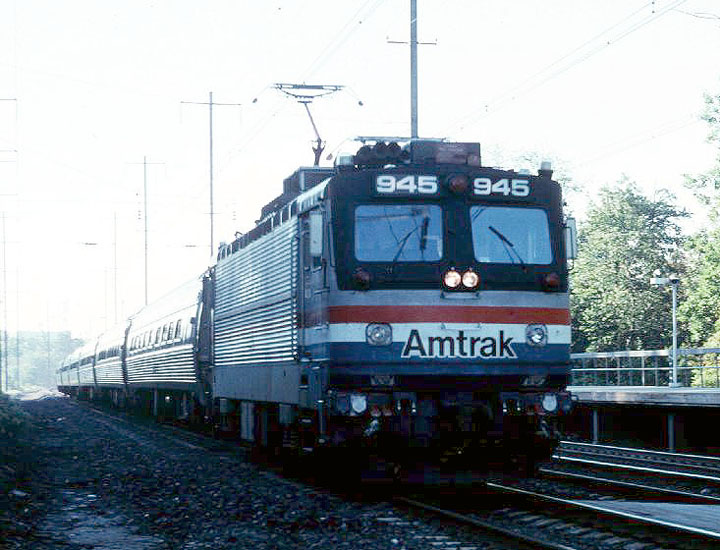
Additionally, Amtrak 945, the museum's AEM7 passenger locomotive and one of the newer pieces of equipment at IRM, has been moved out of the shop and put on outdoor public display. This follows welding work necessitated by the replacement of some windows that were broken by vandals during transportation from the east coast.

Then there's the bad news. Chicago Aurora & Elgin 308 is out-of-service for the foreseeable future following a motor failure. This isn't the first time IRM has had a GE 66 blow up but it is expected to take some time before funds can be raised to rebuild the motor for continued service. In the meantime the museum has three other CA&E wood cars that will remain in regular service.

Finally, Wisconsin Electric Power L7 is also out-of-service with a failed air compressor. On most pieces of equipment this wouldn't be too catastrophic, but the L7 is one of only two pieces of equipment on the PNAERC list to sport a giant CP-19 air compressor. It sits in the cab and removing it for work is an involved process, so for the moment repair work is on the back burner.

Saturday, December 8, 2018

South Shore car leaves IRM

Our sister blog Hicks Car Works confirms that IRM has sold South Shore 37 to an individual in Indiana; the car left on the same truck which carried North Shore 172 to Union on the 7th. Car 37 is far from unique; it's a typical 1929-vintage un-lengthened coach built by Standard Steel and is identical to a number of other cars in preservation including car 34 which operates at IRM on occasion. Following retirement it was allocated to the City of Michigan City, which intended to use it as an office of some sort, but that never panned out and after five years it was sold to IRM to prevent it from being scrapped. Although stored inside for the last 25 years it was never accessioned and its sale permits car 172 to be immediately put into indoor storage.

The sale of car 37 is a rarity: as expansive as its collection is, IRM is not known for selling or trading traction equipment to other museums. In fact car 37 is only the second car on the PNAERC list to be a former possession of IRM, the other being an 'L' car sold all the way back in 1984. At its new home car 37 joins a handful of other South Shore cars - though no Standard Steel-built cars - and its owner's intention is to preserve and restore the car.

Friday, December 7, 2018

North Shore car acquired by IRM

The Illinois Railway Museum has announced that it has acquired North Shore 172, a standard steel coach built by Cincinnati in 1920. This is the fourth-oldest North Shore coach in existence and the only one from that line's 1920 order for cars. IRM is the car's fourth owner; after the North Shore it was very briefly owned by the Hyman-Michaels scrap company but since mid-1963 it has been owned by an ex-North Shore employee. Since the late 1960s it has been stored in Noblesville at the Indiana Transportation Museum, where in the early 1970s it was one of two cars that inaugurated public operations at that site (the other car, CA&E 308, is also at IRM). It was operated regularly until about the early 1990s at which point its deteriorating condition saw it removed from public service. Since 2000 or so it has been stored in the barn at the ITM site as shown above.

The car was moved out of Noblesville in October (for photos and more info see our sister blog, Hicks Car Works) and has been at a temporary storage location in the interim. IRM's intention is to restore the car and operate it along with the museum's fleet of other North Shore cars. With the transfer of car 172 to IRM, there are only three electrics listed on the PNAERC roster under ITM ownership: the three derelict Lackawanna MU trailers stored on the siding in Cicero.

Wednesday, March 28, 2018

Second AEM-7 preserved

The Illinois Railway Museum has announced today that it has acquired Amtrak 945, an AEM-7 mainline electric locomotive built in 1982 by Electro-Motive using components manufactured in Sweden. The locomotive was retired in 2015 and has been sitting in storage in the northeast since then but was moved to Chicago in February. It's not at Union yet; although it's off Amtrak property it is being held pending movement to IRM's site. The locomotive is not intended for operation, given that it is designed for 11,000-volt AC operation and it would be virtually impossible to adapt it for even limited operation on the museum's 600-volt DC overhead. This is the second AEM-7 preserved; number 915 was acquired by the Railroad Museum of Pennsylvania in 2015 straight out of service. And it's the fourth electric locomotive preserved that was built for Amtrak, preceded by older E60 type locomotives 603 and 958.

Tuesday, March 6, 2018

Updates from Union

There are a few changes to cars at the Illinois Railway Museum, where I volunteer, that I noticed needed to be made. Some of these are recent while some are more longstanding ones that happened to slip under the radar. First off, Shaker Heights Rapid Transit 18 (above), which was acquired in 2013 and was the last of the Trolleyville equipment to leave Cleveland, is now undergoing restoration. The car was acquired in complete-but-tired condition and IRM is hoping to make it operational, as it was when in North Olmsted.
CTA 4410, shown above, is one of the museum's 4000-series 'L' cars but has been on inoperable display for a few years since its switch group was disassembled. Everything has now been put back together so that the car can enter the regular operating fleet, so it's been changed to "operated often."
Then there's Detroit 3865, one of five surviving streetcars from the Motor City, which has been taken off of public display and put into storage in one of IRM's off-limits barns. Its condition has been changed in the PNAERC list to "stored inoperable" as has North Shore 763, which was actually taken off of public display a year or two ago and put into one of the off-limits storage barns.
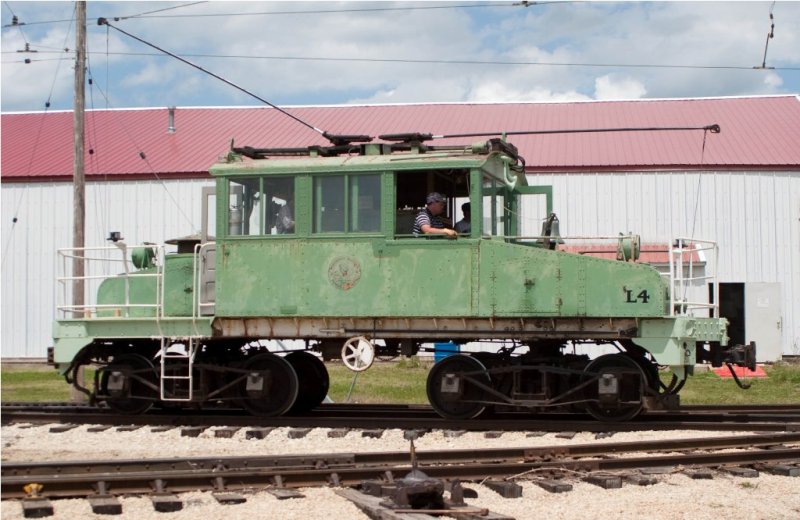
Wisconsin Electric Power L4 has suffered a motor armature bearing failure so, until that is repaired, it is no longer running. Its condition has been changed to "displayed inoperable."
And finally, three of the museum's ex-Illinois Central/ex-Metra "Highliner" commuter cars, numbers 1534, 1630, and 1637, have been changed from "operated occasionally" to "stored operable." These three cars (the fourth owned by the museum has not run at IRM, at least not yet) are in running condition and have been briefly run at Union, as shown below, but for the last year and a half they've been stored out from under wire.

Tuesday, December 19, 2017

Sand Springs car running again

A post on our sister blog contains the information that Sand Springs 68, the only surviving piece of traction equipment from that line, is now once again operational after being out of service for several years to have wheels replaced. Car 68 is quite historic, as its series of cars is regarded by some as being the first true lightweight interurban cars ever built (the car weighs in at only 26,000 lbs or so). It was acquired by IRM in the late 1960s from a junkyard, mostly complete but sans motors and controllers, and was rebuilt extensively by the museum over the course of several decades. The car's record has been updated to reflect its operational status.

Tuesday, September 19, 2017

A selection of Cleveland streetcars

Looking into Cleveland Railway 0140, the single-trucker preserved at the Henry Ford Museum, got me thinking about preserved streetcars from Cleveland. There aren't very many streetcars from Cleveland still around, but the ones that are still around actually offer a reasonable cross-section of the city's electric railway history. Unlike, say, Los Angeles or Chicago, though, where the majority of the city's preserved streetcars are in one place, the extant Cleveland cars are scattered across the continent.

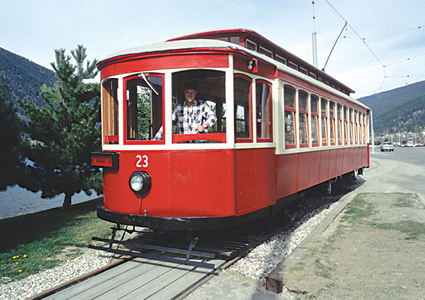
The oldest is car 0140, a Brill product fairly typical of 1890s single-truckers. It's preserved in Michigan, only a few hours from its home. The second oldest is a rather significant car: Municipal Traction 3334, later Cleveland Railway 934 and eventually Nelson Electric Tramway 23. Its design isn't particularly significant, as it's basically a catalog model Brill semi-convertible (albeit built by Stephenson, by then a Brill subsidiary, and modified several times during its life). But it was built for Municipal Traction, the "three cent line" championed by Cleveland mayor Tom Johnson in his populist fight against Cleveland Railway. An extensive account of this fight can be found here. Municipal Traction used a car numbered 3333 for promotional purposes to highlight its three cent fare and this car was numbered just one higher. Eventually it found its way out to western Canada, where it ran in Nelson and eventually became a grounded body. The Nelson Electric Tramway Society has restored it to operation on their riverfront streetcar line.
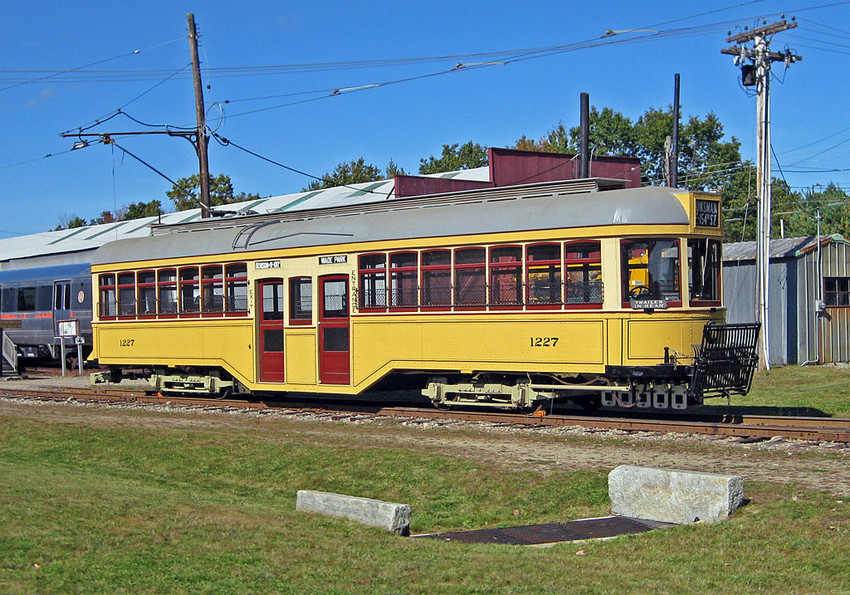
The result of Mayor Johnson's campaign for enforced low fares in Cleveland was that the street railway sought to lower its costs on a per-rider basis. This meant bigger cars and motor-trailer trains to reduce manpower requirements. Thus the next-oldest Cleveland cars are the big center-door cars built by Kuhlman in 1914, of which the best example is likely car 1227, restored to original condition by the Seashore Trolley Museum at great expense. It is likely to eventually be paired with matching trailer 2365 from 1917, currently intact but awaiting restoration work. These cars are large for streetcars, about 50' long each, and seat about 60 people (compared with a seating capacity of just 44 for the standard Chicago car around 1910, the "Old Pullman"). Thus in Cleveland in 1920 you could transport 120 seated passengers with a crew of three, whereas in Chicago you'd need twice as many employees and three streetcars to move that many seats.
The next step in Cleveland streetcar progression was the Peter Witt. None of the city's earliest 1915-built examples survive, nor do the later 1920s Kuhlman cars that ran well into the 1950s. But two examples survive that were actually diverted to Cleveland in 1918 from an order placed by the streetcar company in Rochester, New York. Cleveland Railway 1079 ran in Cleveland for only five years until it was sold for use in London, Ontario in 1923; later it went to Saskatoon, Saskatchewan, where it was retired in 1951 and is preserved (apparently in complete condition, though I've never seen a photo of this car taken in recent decades) at the Edmonton Radial Railway Society.
It's unfortunate that none of the more modern city cars that ran in Cleveland were preserved, particularly the newer Peter Witts and the famous articulated cars, until the PCC era is reached, by which time Cleveland Railway had become Cleveland Transit System. One PCC car built for CTS by Pullman in 1946, car 4223, is being fully restored by the Illinois Railway Museum. The most interesting aspect of this car's design is arguably that it's thought likely that it belongs to a series of cars originally ordered for Baltimore, but cancelled following takeover of that city's streetcar lines by Baltimore Transit. Certain obscure design features in the 1946 Cleveland cars suggest specifications issued by Baltimore, but documentation on this is tough to come by. Regardless, the PCC cars were the last city cars built for Cleveland and end the story begun by cars like 0140 in Dearborn.

Tuesday, September 12, 2017

Charles City Western steeplecab restoration completed

More "old news" in this case is the fact that Charles City Western 300 at the Illinois Railway Museum has had restoration work completed and its status on the PNAERC roster has been changed from "undergoing restoration" to "operated occasionally."
Substantial restoration work was actually completed towards the end of 2016 but the locomotive's first appearance in public service at IRM will likely be this coming weekend for Members Day. This is a unique piece of equipment, as it is the only existing locomotive built by McGuire-Cummings. That firm built a number of similar steeplecabs for a variety of interurban lines, many of them in Iowa (for some reason McG-C was popular among Iowa lines), but most examples succumbed relatively early.

This locomotive was originally acquired by IRM in 1972 as a parts source but its historic significant was recognized fairly quickly and it was retained, in dead storage for many years and then as the subject of a restoration effort that lasted some 15 years. It was designed for operation on either 600v or 1200v DC with the air compressor running off 1200v while the motors and control ran off of 600v via a dynamotor. The restoration has replaced the original CP-30 air compressor with a 600v example of the same type and has simply wired around the dynamotor to feed the various 600v systems, leaving the dynamotor itself in place as a relic.

Friday, August 18, 2017

Chicago "L" car progress

I continue to try and catch up with changes made to the PNAERC list during the past several months. One change (well, two changes) involve the Illinois Railway Museum's collection of wooden "L" cars from Chicago. IRM has been progressing through its wooden "L" car collection over the last decade and steadily restoring these formerly dilapidated cars one by one. In late 2016, the eldest of the collection - Northwestern Elevated Railroad 24, formerly listed on PNAERC under a later number, Chicago Rapid Transit 1024 - was outshopped following the completion of a four-year restoration and backdating effort.
The car has also been put into revenue, though not constant, service at the museum. As such, the car's status has been updated from "under restoration" to "operated occasionally." In turn, the next wooden "L" car in line for restoration work has been moved into the shop. This is Chicago Elevated Railway 1754, built by Jewett in 1906. It's something of a technological bridge between the earlier cars like NWERR 24 and later cars like CRT 1797, which was restored from 2010 to 2012. It was also upgraded during the 1920s with newer motors and electric equipment. Car 1754 was acquired by IRM out of work service and in somewhat deteriorated shape, so while it has been operated occasionally during the museum's Trolley Parade events, it's never been usable for passenger service.
Its status has been updated to "undergoing restoration" - and judging by past results, will be updated again to operable status soon enough.

Friday, August 11, 2017

Ex-Virginian electric arrives in Illinois

Another piece of news to catch up on is the arrival at the Illinois Railway Museum of ex-Virginian, ex-Norfolk & Western, ex-New Haven, ex-Penn Central, ex-Conrail electric locomotive 4601. For a relatively modern piece of equipment (built 1956 by GE) this beast has had a fairly eventful life. Twelve of these ignitron rectifier locomotives were built for coal hauling on the Virginian electrification, replacing old jack-shaft boxcab electrics dating to the 1920s. When the N&W took over the Virginian in 1959 it changed traffic patterns, assigning mostly trains of empties to the former Virginian main line. With less tonnage to haul the N&W de-electrified the Virginian in 1962 and put the six-year-old ignitron rectifiers, known as class EL-C on the Virginian, up for sale.

The eleven remaining locomotives (one had been rebuilt as a slug and was acquired for parts) were bought by the New Haven in 1963 and moved to Connecticut, where they replaced older 1930s electric locomotives in freight service. Reclassified EF-4, the eleven units were renumbered 300-310. All eleven stayed in service with Penn Central, renumbered 4601-4610 (301 was wrecked about the time of the PC takeover and assigned number 4600 but scrapped about the same time), and later entered service with Conrail with the same road numbers

IRM's unit was in the middle of rebuilding work when Conrail ended electric freight service in March 1983. Rebuilding work was completed but the 4601 was immediately mothballed. Interestingly, this work included replacement of the ignitrons with silicone diode rectifiers. The ten remaining locomotives were stored briefly and then traded in to GE in 1984 (though one, Conrail 4604, was sent to the Virginia Museum of Transportation around this time and restored as Virginian 135 - it may not have been returned to GE). CR 4601 was the subject of a campaign to have it preserved and in 1988 it was transferred - sans transformer and numerous internal components - to the Railroad Museum of New England in Connecticut. It remained there, largely untouched, until acquired by IRM in trade in 2014. It was moved to Altoona in 2015 to be cosmetically restored but the deal to accomplish this fell through and the locomotive was moved to Union in July 2017. The museum intends to repaint the rectifier into New Haven colors which would make it the only New Haven electric locomotive preserved as such.

Wednesday, September 21, 2016

Newly operational cars

This past weekend I was at the Illinois Railway Museum for the museum's annual Members Day operations and there was some equipment that ran for the first time at the museum and/or for the first time in many years. Milwaukee streetcar 972 operated for the first time since 1999 and the first time in revenue service since perhaps 1978. Chicago elevated gate car 24, which is nearing the end of a complete restoration which includes back-dating to its 1914 condition, operated as a motor for the first time since it suffered a motor flash-over while operating to IRM under power over the North Shore Line in 1958 (it was used as a control trailer during the 1970s though). And the first public operation of Illinois Central "Highliner" double-deck MU cars took place with cars 1630 and 1637 making a few short demonstration trips. I suspect that this is the first-ever museum operation of a double-deck electric car in this country - though only if you exclude European cars that have been imported.

Friday, August 12, 2016

Miscellaneous changes

There haven't been any major changes recently, but a few minor ones have been made relating to restoration progress at a couple of different museums. First, National Capital has released a photo of single-trucker 522, which has recently been cosmetically restored. More information can be found here. It had been on a Brill 21E (modified for rail grinding use) but Baltimore Streetcar Museum traded them a correct older-type Lord Baltimore truck for the car. In turn, car 4662 at BSM is supposed to have a Brill 21 but had been placed on a Lord Baltimore shop truck many decades ago. I'm not positive whether 4662 will receive 522's Brill 21 (confused yet?) but I suspect that it will get some sort of 21 truck.

And in other news, the Illinois Railway Museum has gotten "L" car 24 running for the first time since 1958. See here for photos. The car had formerly been listed on PNAERC as Chicago Rapid Transit 1024 but the restoration project which is now in its later stages has backdated the car to its earlier owner and number, Northwestern Elevated Railroad 24.

Thursday, July 28, 2016

IC "Highliners" added

I've added a total of fourteen (!) recently-preserved "Highliner" double-deck MU cars from the Illinois Central's Chicago suburban electrification to the roster. Of those, ten have been acquired by the Museum of the American Railroad in Frisco, Texas for use as classroom cars. They were moved to Texas in early 2016 and are currently in storage, though I'm not certain whether they're at the Frisco site or stored somewhere nearby. The other four cars were acquired in mid-2015 by the Illinois Railway Museum, which intends to retain two and scrap the others for parts. Which ones will be kept has not yet been determined, and for the time being all four are stored on the IRM campus. As of a couple of weeks ago, work had begun on inspecting these cars and making them operational. Car 1534 was the first to be inspected and had the honor of becoming the first "Highliner" to run in preservation (as far as I know, though there are some in Boone that are potential runners).