Tuesday, September 12, 2017

Charles City Western steeplecab restoration completed

More "old news" in this case is the fact that Charles City Western 300 at the Illinois Railway Museum has had restoration work completed and its status on the PNAERC roster has been changed from "undergoing restoration" to "operated occasionally."
Substantial restoration work was actually completed towards the end of 2016 but the locomotive's first appearance in public service at IRM will likely be this coming weekend for Members Day. This is a unique piece of equipment, as it is the only existing locomotive built by McGuire-Cummings. That firm built a number of similar steeplecabs for a variety of interurban lines, many of them in Iowa (for some reason McG-C was popular among Iowa lines), but most examples succumbed relatively early.

This locomotive was originally acquired by IRM in 1972 as a parts source but its historic significant was recognized fairly quickly and it was retained, in dead storage for many years and then as the subject of a restoration effort that lasted some 15 years. It was designed for operation on either 600v or 1200v DC with the air compressor running off 1200v while the motors and control ran off of 600v via a dynamotor. The restoration has replaced the original CP-30 air compressor with a 600v example of the same type and has simply wired around the dynamotor to feed the various 600v systems, leaving the dynamotor itself in place as a relic.

Monday, September 11, 2017

Two Boston PCC cars cut up

It hasn't been an auspicious summer for Boston PCC cars. Following the scrapping of the ex-Dallas double-ender a few months ago, the Seashore Trolley Museum this past weekend cut up two more Boston cars. These were 3099 and 3122, both "standard" Boston cars built in 1945 by Pullman-Standard.

The photos above were taken in 2007. These cars were not accessioned parts of the Seashore collection; in other words they hadn't been acquired for the purpose of ultimate preservation, but rather had been purchased as parts sources and had been utilized mainly as storage lockers for spare components. In 2015 or 2016 they had been moved due to yard construction but at that time it was discovered that both cars were experiencing serious frame failures, so the parts were unloaded from the cars and they were designated for disposition.

This is not a great historic loss. Seashore has another car from this exact order, 3127, preserved as part of its historic collection and that car has been repainted to its earlier orange-and-cream service livery. Another car from the order, 3100, is preserved at the Connecticut Trolley Museum and has been the subject of on-again, off-again restoration work. And of course there are many Boston PCC cars of substantially similar design preserved at various museums and on the MBTA itself on the Mattapan line.

Saturday, September 9, 2017

Mystery streetcars in Seattle

It's time for more mystery streetcars! Today I'm turning my attention to a pair of streetcars preserved at the Ballard Terminal Railway in Seattle. The Ballard Terminal, whose owner I believe also owns these two cars, has a very short "yard" just off of West 45th Street in Seattle which consists of a single curving siding. At the end of the siding sits an Oporto single-trucker, but I'm not particularly interested in that car because it doesn't qualify for inclusion in the PNAERC list. However on the ground along the fence are two car bodies that probably do qualify: a Birney and a double-truck turtleback roof car of (presumably) Stone & Webster design. They're visible on Google aerial photos and the roof of the double-trucker can be seen on Google Street View.

So... anyone know what these cars are? I know that Seattle Municipal Railway had both turtleback-roof cars and Birneys, as did - I believe - Tacoma Railway & Power. Both of those lines can boast of only a single Birney body currently on the PNAERC list so assuming the two Ballard cars are local they are fairly significant.

Friday, September 8, 2017

Dallas/Boston PCC scrapped

I can't recall offhand the last time that a car on the PNAERC list went directly from "undergoing restoration" to "scrapped" but I suppose there's a first time for everything. It was brought to my attention that this summer the McKinney Avenue Transit Authority in Dallas scrapped the ex-Dallas double-ended PCC car that had arrived there only a year and a half earlier.
The car was built by Pullman-Standard as Dallas Railway & Terminal 612, becoming Boston MTA (and later MBTA) 3334 in 1959 when it was sold for use in Massachusetts. In 1991 it was acquired by Trolleyville and moved to Cleveland, where it was stored indoors for most of the time until the Trolleyville collection was liquidated in 2009. At that time it was acquired by MATA but, lacking storage space, it was moved to the Illinois Railway Museum and stored there. It was moved to Dallas in December 2015.

As recently as early 2017 the car was undergoing a major rebuilding with the goal of making it operational; it had been stripped down to the steel shell and the entire car had been sand-blasted. But it seems that the frame was more heavily deteriorated than expected and McKinney decided that it would be uneconomical to repair the car for operation. So in May or June it was cut up. It's worth remembering that MATA is not a museum; they're basically a tourist railroad with a franchise to provide a public transportation service. So their primary mission isn't to preserve or restore Dallas streetcars, it's to provide reliable service along their street railway route.

Car 612 was far from unique. A dozen other other members of this class exist in various museums, though none in operating condition and only a couple retained as accessioned collection pieces. But all of the other examples are located in the northeast - none in their original home in Texas.

Thursday, September 7, 2017

Black Hills Central update

As I did some web surfing looking for more information on Utah interurban cars, I came across an update on Bamberger 403. This classic Jewett wooden interurban car was built in 1910 as a motorized combine but was later rebuilt by Bamberger as a coach trailer. It strongly resembles (well, resembled) cars built for the North Shore Line in Chicago, of which none survived.
But it doesn't resemble them much any more. It was stored in steadily deteriorating condition at the Heber Valley Railroad in Utah until 2012, when it was sold to the Black Hills Central and moved to South Dakota. It appears, from an ATRRM blog post, that the BHC rebuilt it last year for use as a locomotive-hauled coach. It fits in well with the other ex-interurban cars in their regular train, the others being from the Oregon Electric, but it's too bad that the car has lost much of its classic appearance to a somewhat clumsy, if admittedly pragmatic, rebuilding. That said, the car wasn't exactly complete and original when it went to South Dakota, and at BHC it should be well maintained.

Wednesday, September 6, 2017

Saltair additions and a deletion

So it came to my attention, due to a thread over on RyPN, that the Utah State Railroad Museum in Ogden has a pretty nice online roster which includes a fair amount of information on their collection - including the four pieces of traction equipment they own. Only two of these, Bamberger "Bullet" car 126 and Salt Lake & Utah freight trailer 851, were already on my roster. The other two, big Salt Lake Garfield & Western ("Saltair") open car trailers whose numbers are unknown, were not on my roster. That has now been corrected.
The two cars (now on the roster here and here) are from the 301-313 series of cars, built in the company shops in 1922 using parts from older 1890s-era freight cars. The museum's website roster has a great deal of mechanical information on these cars which has also allowed me to flesh out the listing for an identical car at the Western Railway Museum in Rio Vista (that car is thought to be fleet number 306). Both of the cars owned by the Ogden museum are stored, along with the Bamberger "Bullet" car body, at the Ogden Business Depot on the north side of Ogden near the county fairgrounds. The Google Maps aerial photo above shows, from left to right, one of the open cars; the "Bullet" on a flatcar; the other open car; and the remains of dome car "Moon Glow." There's also a brief article (with photos) about the open cars, forecasting a restoration which I believe has not yet happened, at this link.

And the roster linked above also contained a piece of information about yet another example of these big Saltair open cars which I was able to confirm independently, namely that the fourth of the previously surviving examples of this type was scrapped at the Heber Valley Railroad in 2009 following serious damage from a fire set by an arsonist. So that car has been removed from the roster, leaving Heber Valley on the PNAERC list with only three Lackawanna MU cars used in locomotive-hauled train service.

Tuesday, September 5, 2017

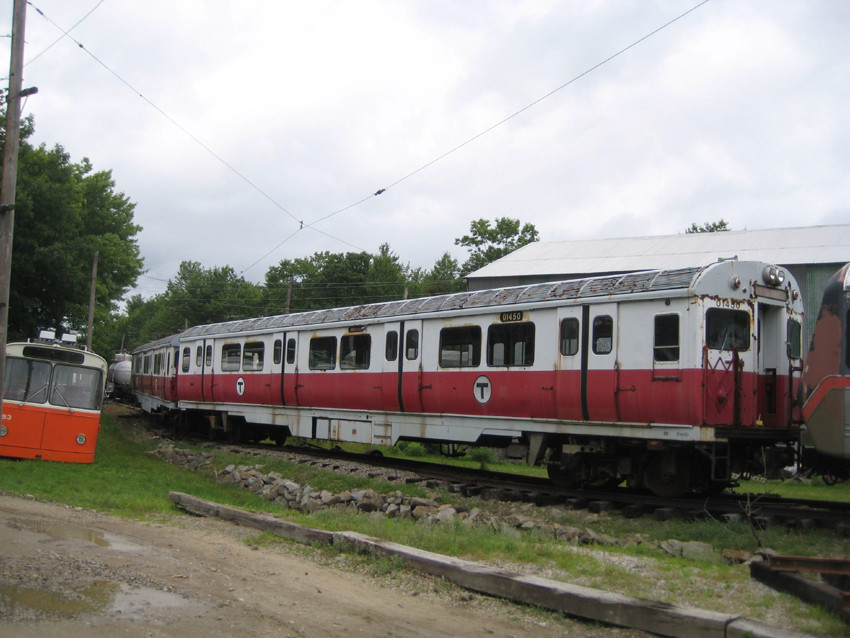
MBTA 01400s running

2009 photo by Jason Grant

Within the last couple of weeks Seashore volunteers have gotten their married pair of MBTA 01400 series Red Line subway cars operating. These cars came to Seashore in 1997 following retirement from service but have operated little, if at all, during the last 20 years. But museum volunteers have now mounted trolley poles (unprototypical, but necessary for operation) to the car roofs and gotten the pair running. It's not clear how much use they'll see, or whether they're cleared for public/revenue operation, but their status on the list has been changed to "operated occasionally."

The 69'-long 01400s were the last Red Line cars built of steel and the last cars built for that line before the MBTA took over from the Metropolitan Transit Authority. They were constructed by Pullman-Standard in 1963 and originally wore a flashy (for subway cars) livery of dark blue and white with gold striping. Seashore is currently raising money to repaint its pair in that original, and unique to this series, color scheme.