Wednesday, January 29, 2025

Tarped Cars on Truck Trailers in the Northeast

Thanks to Bill Wall for supplying news and photos regarding the conveyance of New Jersey Transit 5221, a utility/line car built in 1912, to Branford today. The car was moved by Silk Road from its recent home at the Kinkisharyo plant in Piscataway, New Jersey, and was unloaded in East Haven.
Car 5221 was built by Russell in 1912 as a snow plow and freight motor for the Trenton Terminal Railroad (later Public Service Railroad, then Public Service Coordinated Transport) system in New Jersey. At some point it was rebuilt as a line car, and in that guise it stayed in service on the Newark subway until it was transferred off the property in 2009. The car bounced around: it went to the National Capital Trolley Museum for a while, then was at Lyons Industries in Pennsylvania for truck rebuilding c2016-2017, and afterward ended up in Piscataway. The photo above, from this blog, was taken around 2018, but in 2019 the car was tarped and put outside. (The four photos below were all taken by Bill Wall.)
For five years or so, the car looked like this, tarped with a shrink-wrap "boat tarp" next to the Kinkisharyo building.
But through whatever means, the car was acquired by Branford. Above, it's shown loaded on a trailer.
And these last two photos, taken today, show the car on the line at Branford.
This is only the second line car in Branford's collection, and their first double-truck line car. (Oddly enough, among the "three sisters" that started the traction preservation movement in New England - Seashore, Warehouse Point, and Branford - there are only six line cars preserved among them, and 5221 is one of only two that are double-truck cars.) Car 5221 is one of six intact cars from the PSCT system before the PCC era, and four of those cars are now preserved at Branford.

The second car on the move is shown below (apologies for the thumbnail-sized image, which is a screen grab from a video posted by Seashore). You'd be hard pressed to tell from the tarp, but this is the famous Berkshire Hills, the business car from the Berkshire Street Railway that is the only survivor from that storied system.
This car was built by Wason in 1903, retired way back in 1922, and sold in 1932 for use as a diner. Following a 1994 fire that caused substantial damage, the body was acquired by Seashore in 1995, where it has been stored ever since. The car is now en route to its new home at the Shelburne Falls Trolley Museum, a transfer that has been planned for over a year. This is the second car on Seashore's "re-homing lists" to go to a new home; the first, MBTA line car 3283, also went to Shelburne Falls. The SFTM collection now totals five cars on PNAERC; Seashore's stands at 189 pieces; and the NJERHS is down to six cars while Branford is up one to 91 cars.

Monday, January 27, 2025

Global Air Compressor Taxonomy Change

That post title sounds like I've been playing with a random word generator, but it actually does mean something. We've made a global change to the PNAERC list to update how we classify air compressors. Now, while this change applies to all listings, it doesn't actually affect all the listings, because of course not every car on the roster has an air compressor listed. But for the ones that do, the entries have now all changed, thanks to some deft coding by our webmaster, Jeff Hakner.

First, we've added manufacturers to the air compressor listings. What before was simply a "CP-27" is now a "GE CP27." We've always included the manufacturer for trucks, motors, and control*, but only now have we extended that to compressors. Second, I've standardized on omitting hyphens. The nicely painted compressor shown above used to be a "D3-EG" on PNAERC, but now it's a "WABCO D3EG." Omitting hyphens has worked fine in the past for fleet numbers.

*K-controllers were built to identical specs by both GE and Westinghouse, so we omit a manufacturer name for them. Other types of control, like MU control and PCC control, typically have a manufacturer indicated.

Friday, January 17, 2025

Two Cars for Rockhill

Back in November, it was reported here that two cars from the Middletown & Hummelstown were headed to the Rockhill Trolley Museum. Those cars both headed to Rockhill Furnace today and were unloaded this afternoon. Thanks to Joel Salomon of RTM for the photos and update! The first car, shown above after being un-tarped, is Lewistown & Reedsville 23, a unique and historically significant center-entrance car that ran most of its service life very close to Rockhill Furnace. The second car, shown below on the Silk Road trailer, is York Railways 162. This is a Brill-built curve-sider identical to car 163, already restored and operational at RTM, and the museum evidently intends to preserve car 162 as a house to depict post-service uses of electric car bodies.
With this transfer, the collections of both RTM and M&H stand at 22 cars on the PNAERC list. The M&H collection will continue to shrink, though; a few of the basket cases are intended for scrapping, while some other cars will likely go to new homes at other trolley museums.

Thursday, January 9, 2025

More Miscellany - Relocation, Removal, Disappearances

Today's entry is something of a catch-all of recent updates. First, thanks to Bill Wall for sending the above photo showing Public Service Coordinated Transport 5173. This is what remains of a four-wheel snow sweeper from the Newark subway; it burned in a fire in the subway in 1972 but its frame has been owned by the North Jersey Electric Railway Historical Society since 1980. It's been stored in Phillipsburg for years, but was just relocated to join the rest of the NJERHS collection in Piscataway. I'm looking for information on this thing, especially who built it and when - anyone have a good PSCT roster handy?

Next up, we have a removal: Scarborough Rapid Transit 3027, a linear-induction-motor car shown above, has been dismantled by the Halton County Radial Railway. HCRR acquired two of these cars, 3027 and sister car 3026, with the idea of dismantling one, so this is not unexpected. The Halton County roster currently stands at 54 cars on PNAERC, while the overall list has 2,088 cars.

Finally, I tell you a mystery: two Texas Electric freight trailers have disappeared from the grounds of the Texas State Railroad in Rusk, Texas. The two are TE 605, built by St. Louis in 1907 as Texas Traction coach 6, rebuilt as a freight motor in 1914, and rebuilt as freight trailer 605 in 1918; and TE 613 (shown above), built in 1907 as Texas Traction coach 7, rebuilt c1914 as an RPO-coach, and then rebuilt in 1925 as a freight trailer. For years, both cars sat on the ground at the east/southeast end of the TSRR yard in Rusk. But at some point, they disappeared, both from Street View and (as near as I can tell) from aerial photos. Does anyone know for sure what happened to them? I believe they were just used for storage, so my best guess is that they were dismantled, but I'd love to know for sure. I've changed the status of each car to "unknown" pending word one way or another. (The third body owned by TSRR, ex-C&LE box motor 646, is still visible on Google Street View as recently as a year and a half ago.)

Monday, January 6, 2025

One Removal and a Couple of Questions

Thanks to Gord McOuat for confirming that the Halton County Radial Railway has dismantled Toronto CLRV 4010 as a parts source.
Car 4010 was the first CLRV to go to a museum, back on November 4, 2019, and operated at HCRY as soon as it arrived. But the museum has since acquired several other examples of the type, with the idea that the one or two cars in the worst condition would be dismantled as parts sources, and that ended up including 4010. This brings the number of CRLVs currently at Halton County down to "only" eight, though a couple of those are owned by other museums and just stored in Rockwood for the moment.

Supposedly, Halton County has also dismantled one of its two Scarborough Rapid Transit cars (the ones acquired just a few weeks ago) - but I'm not sure which one. Anyone know?

And in unrelated news, Joshua Sutherland has sent me an update on Hanna Mining 306, a large industrial steeplecab built by GE in 1928. This locomotive has been on display, albeit in somewhat neglected condition, at Hill Annex Mine State Park in Minnesota. As it turns out, that state park was permanently closed this summer to allow mining and extraction work to resume. It sounds like the old equipment and buildings may simply get demolished to make way for resumption of business (or maybe they're already gone) but I don't know for sure.

If Hanna Mining 306 gets cut up, it would not be a huge loss. Three other identical locomotives from this operation have been preserved, including one preserved indoors in impeccable condition in Duluth and two more displayed outdoors in decent condition elsewhere in the region. For the time being, locomotive 306's status has been changed to "unknown." Any updates on what happens to the artifacts at this site are appreciated.

Saturday, December 28, 2024

MU Cars West!

A Facebook page called Northwest Daylight Productions posted today that the three ex-Knox & Kane, ex-Lackawanna MU motor cars recently owned by the Heber Valley Railroad in Utah have been sold to the Roaring Camp tourist railroad operation in Felton, California. All three cars - 3568, 3571, and 3593 - have apparently been moved or are in transport. These cars are, frankly, in rough shape. They weren't maintained very well in their later years on the Knox & Kane and, as effectively backup equipment, have received only minimal service (and no paint) since arriving in Utah in 2005. They're definitely not up to the standards of Heber Valley's beautiful fleet of heavyweight cars they acquired from Canada a few years ago.
The above photo, from the aforementioned Facebook post, shows a common problem with the 1930 Lackawanna motor cars: the aluminum roof sheathing separating from the tops of the steel car sides. Thanks to Sean Bowen for alerting me to the cars' arrival in California and to David Wilkins for confirming the sale by HVRR.

Unless the Roaring Camp organization is planning to expand into a new market, these cars are presumably intended to go into service between the home base in Felton and the beachfront in Santa Cruz. I've had the chance to ride both the short, but mountainous, narrow-gauge railroad in Felton and the standard-gauge line down to the beach (see here) and both trips were very enjoyable. When I rode the standard-gauge line, the equipment in use was ex-Boston & Maine wood cars, which made for a very nice experience. Hopefully, these MU cars are being used to bolster, rather than replace, the wood fleet on this line.

Monday, December 23, 2024

Major Thinning of the Exporail Collection

A fascinating, and unexpected, document just issued by the Canadian Railway Museum (CRM, aka Exporail) in Delson-St. Constant, Quebec, just appeared on the Heritage Rail Alliance news feed. CRM has completed a two-year review of its collection and has decided to deaccess 40 pieces of rolling stock. This includes no fewer than eight steam engines; five internal-combustion pieces; seven freight cars; and eight passenger cars. The list also includes 11 pieces of traction equipment, all of them on the PNAERC roster.
CRM's deaccession document is thin on information about the equipment, but it seems very well thought out and their transparency about the process is laudable. They're offering the deaccessed equipment "for exchange, transfer or sale until June 1st, 2025," and they include a prioritization calendar:

December 2024, offered to Canadian railway museums
January 2025, also offered to Canadian museums of other types
February 2025, also offered to Canadian historical associations and government entities
March 2025, also offered to U.S. railway museums
April 2025, also offered to U.S. government entities
May 2025, also offered to other U.S. enterprises

The breakdown of this prioritization timetable seems quite reasonable to me, and I commend CRM on announcing it clearly at the start of the process.

Of course, my interest here is not in Pacifics and Mikados, it's in the traction pieces. I'll confess that I have less familiarity with the CRM collection than I do with any other major traction collection on the continent. It's by far the largest traction museum I've never visited in person. But it's clear that quite a few of the pieces being deaccessed are complete and of real historical significance, so I hope they find good homes.

The first piece on the list is New Brunswick Power 82, a single-truck deck-roof car built by Ottawa in 1906. This is the only carbody on the list of traction equipment - everything else is complete, or at least largely so. This is a unique piece: it ran its whole career in Saint John, NB, and was still a hand-brake car when retired around 1947. I believe it's the only preserved electric car from New Brunswick. It's on some sort of single-truck shop truck and appears to be in nice cosmetic condition.

Next up is Montreal Tramways 1317, a wood-bodied, single-ended PAYE car constructed in 1913 by Ottawa. This car is complete and appears from photos to be in decent, if tired, condition. CORRECTION: I had previously written that this piece was duplicated in the CRM collection by car 1339, but that's not accurate. Car 1317 is actually the only surviving member of the 1200-1324 series, which was the first car design built for the newly unified Montreal Tramways system in 1913. Car 1339 is part of the 1325-1524 series, which was very similar but had an arched roof rather than the railroad roof of the 1200-series cars.

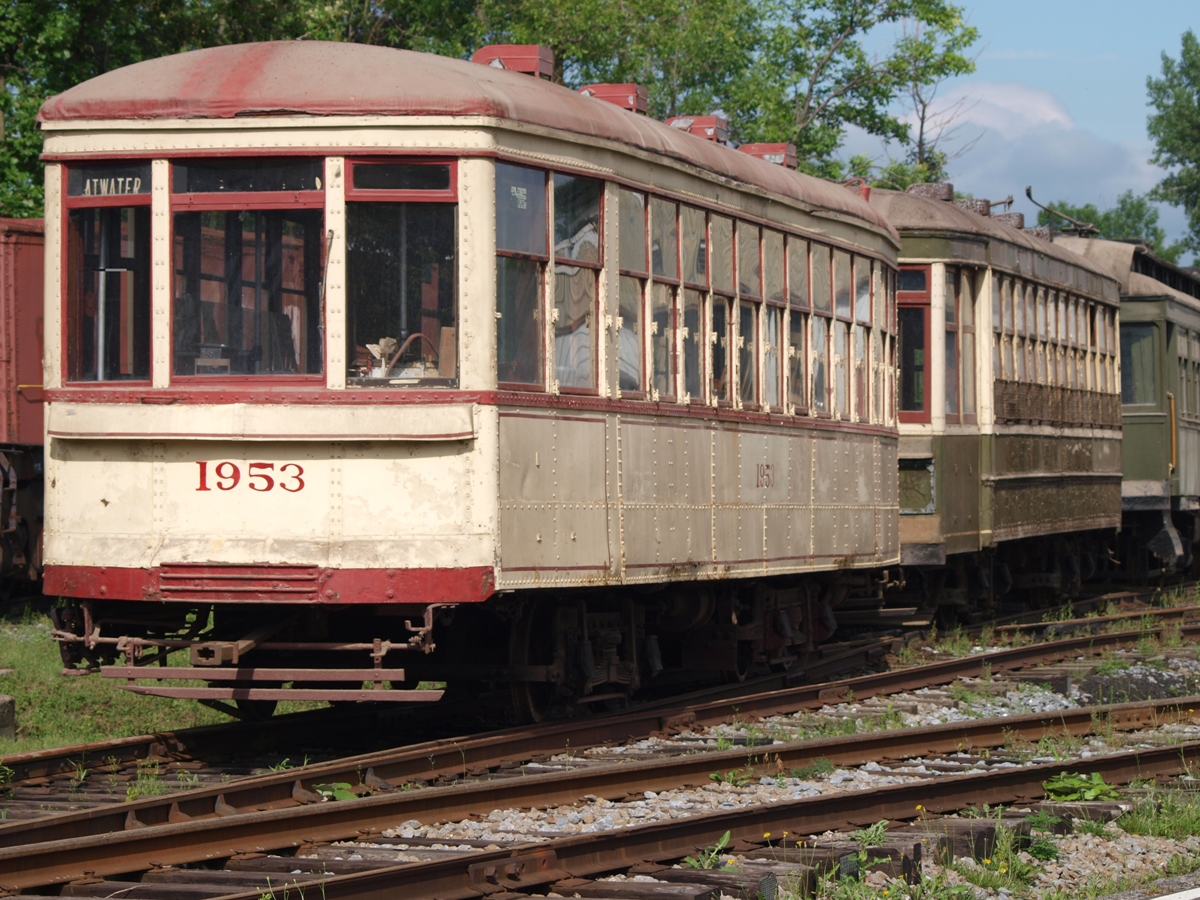
The other Montreal streetcar on the list is Montreal Tramways 1953. This, too, is a duplicate in the CRM collection, and was built as part of the same order as MTC 1959, the museum's most regularly operated streetcar. These cars are single-ended arch-roof cars built in 1928 by Canadian Car & Foundry. Car 1953 was privately owned for many years after retirement and didn't come to CRM until 1975. It's missing seats and some other parts.

Half of the six non-revenue pieces from Montreal Tramways preserved at CRM are on the list, and the first is MTC 5001, an angular steeplecab built in the company shops in 1917. It's virtually identical to MTC 5002, preserved at Branford and currently undergoing restoration work.

The next piece is Montreal Tramways 3151, a single-ended cab-on-flat work motor built by Canadian Car & Foundry in 1925. From the above photo, it appears to be largely intact but in rough shape, and it doesn't seem to have been the focus of much attention in recent years. (Incidentally, the above photo - taken by my father on a trip to CRM in 2002 - seems to be just about the only photo anyone has taken of MTC 3151 in the last few decades. This photo even appears on CRM's own deaccession document!)

Toronto Transportation Commission TP10 is one of only two pieces of TTC equipment preserved at CRM. It's a single-end wedge plow built in 1946 by National Steel Car and retired around the late 1970s. It's identical to TTC TP11, preserved in operating condition at Halton County. From what I can tell, it's largely complete but in rough shape.

The third piece of Montreal Tramways non-revenue equipment is MTC Y5. Of all the equipment on the deaccession list, this is the one that surprises me the most. Y5 is a motorized streetcar truck fitted with grids and a controller for use as a shop switcher. Only a couple of these things still exist in preservation (including another unnumbered example from Montreal, preserved at Branford). This one, homebuilt and dated to 1912, has been (or, at least, was) on display for years in CRM's impressive Exporail pavilion, so it's clearly in good cosmetic shape. It also takes up almost no space.

Then, we get to the interurbans. London & Port Stanley 10, shown here in a photo from the 1970s (I've never been able to find anything more recent), was one of the big all-steel cars built for that system by Jewett in 1915. It's been at CRM since retirement in 1962 but is obviously in rough condition. It's one of three cars of this series in existence (the other two are both at Halton County), and similar car 14 - built two years later and some 12' longer - is under restoration at the Elgin County Railway Museum.

Montreal & Southern Counties 104 is an attractive suburban wood car built by Ottawa in 1912. As with most of the other cars on this list, it appears to be complete but has suffered somewhat from storage outdoors. I'm not very familiar with the M&SC roster, but this car appears largely identical to M&SC 107 at Halton County, except that the latter car is a combine.

A very unusual piece of equipment for the PNAERC roster is next on the deaccession list: Quebec Railway Light & Power 105. This is one of the oldest cars on the PNAERC list, having been built by Jackson & Sharp back in 1889, nearly before "the invention of electricity." It started out as a steam-road combine but was later hauled as a trailer by QRL&P interurban cars like car 401, preserved at CRM. This car is so unusual as an electric car that its significance is somewhat limited outside of Quebec, but as an example of an 1880s passenger car, it seems quite historic. My impression is that it is complete and in moderate to good condition.

And the final piece of traction equipment being deaccessed is Canadian National 6742, a mainline commuter MU trailer built by Canadian Car & Foundry in 1952. It was built for the CN Montreal suburban electric line and joins similar motor car 6734 in the CRM collection. As with QRL&P 105, this is a trailer that's being deaccessed while its matching motor car remains in the collection. Several trailers of this series are operated by tourist railroads that haul them with locomotives, but this this may be the only one of its type preserved in authentic MU configuration.

In summary, this is the largest collection of traction equipment to be deaccessed by a museum in the last decade or so except for Seashore's recent "re-homing" program - but a quick look at what is being offered makes it clear that the equipment being deaccessed by CRM is far more valuable and significant, mainly for its completeness. The museum is also deaccessing more than 25% of its traction collection, which I think is unprecedented for a museum that is relatively stable overall. CRM is being admirably transparent in their process, and I hope that the result is that most or all of these pieces find the best possible new homes.