Thursday, August 24, 2017

Seashore equipment updates

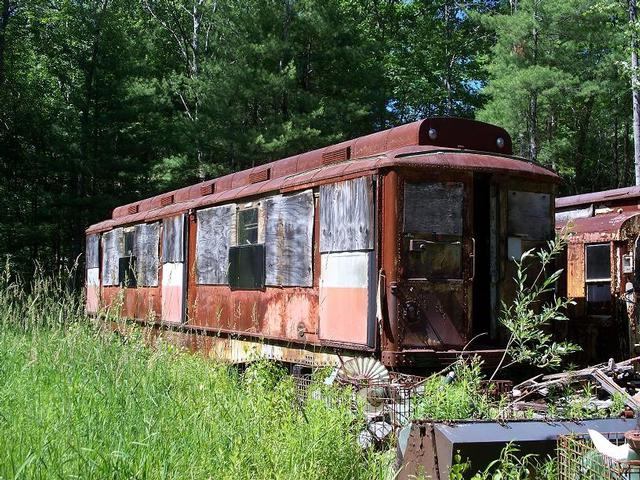
As I go along, I try and periodically check on some museums' websites to see whether they've added more roster information to fill in gaps in the PNAERC record. I spent a bit of time perusing the Seashore website and was able to update a few of the MBTA rapid transit cars in their collection. There are two steel "main line elevated cars" that are not accessioned but are kept as parts storage (one shown above), 0986 and 0996, that had dates of acquisition (1996) added; I also added master controller type (CJ129) to 0719 and the assorted other Cambridge-Dorchester cars in the collection.

While I was at it, I also corrected the ownership history of Lynn & Boston Street Railway 3256, a very old open car body owned by Seashore. It turns out the Lynn & Boston was one of the companies that was incorporated into the Boston & Northern in 1901, while the B&N itself was incorporated into Bay State Street Railway in 1911. The car is actually listed as BSSR 3256 on the Seashore website these days - I may change its "primary" owner to BSSR, assuming that's an "official" change - so it presumably lasted at least that long in service. I still don't know when the car was retired from service but then again the Seashore website doesn't list that date, so it may be one of those facts lost to history.

I'm always looking to add random bits of information to fill in gaps in the database, of which there are far too many to count. If you ever see a bit of information - an acquisition date, a prior owner, an unidentified piece of electrical equipment - that is missing, please let me know!

Wednesday, August 23, 2017

Southwest Missouri 60 photo

Dave Hamley from the Pennsylvania Trolley Museum forwarded me the above photo, from an unknown online source, taken (apparently recently) of Southwest Missouri 60 in operation in Webb City, MO. It's an intriguing photo, particularly since the last I had heard, this car was operating using an on-board gas engine out of an old Corvair to power it. However it now appears that it has this interesting little thing coupled to it.

Anyone know what the arrangement is here? It looks kind of like that might be some sort of remote-control locomotive that is pushing/pulling the electric car. Alternately it could be a more standard tow-along generator powering electric motors under the car. But I simply don't know.

Tuesday, August 22, 2017

Two freight trailers added to PNAERC roster

So here's another piece of good news: I've managed to identify a pair of cars that have long been on my list of "mystery cars." They're both interurban freight trailers from the Texas Electric that are on the grounds of the Texas State Railroad in Rusk. With help from TE expert John Myers they've been identified as cars 605 and 613 and added to the PNAERC list.

Both have intriguing histories. They both started life as handsome railroad-roof Texas Traction interurban coaches built by St. Louis Car Company in 1907; car 605 was originally TT 6 and 613 was originally TT 7 (a photo of identical car 8 is here). After a few years car 6 was rebuilt by TT into a freight motor and renumbered 554; around the same time car 7 was rebuilt from a straight coach into a coach-RPO car and renumbered 356. TT was incorporated into Texas Electric in 1916 and both 356 and 554 initially kept their numbers. Car 554 was rebuilt in 1918 into its current form as an unpowered interurban freight trailer and renumbered to 605; seven years later, in 1925, car 356 was also rebuilt as a freight trailer. Both would have been retired when TE quit in 1949 and both were retrieved and moved to Rusk in 1996, at the same time freight motor 501 and freight trailer 608 were moved to Van Alstyne and put on display there. Click here for a photo of 605 and click here for a photo of 613.

So the Texas State Railroad's collection of grounded interurban freight equipment has tripled, with the two native freight trailers joining the ex-C&LE freight motor that arrived in Rusk around the late 1990s as well. It's a bit of an odd collection for a steam tourist line but while the cars are all used for storage, they're also being taken care of and do qualify as "preserved" by my standards. Hopefully they are kept up going forward. This also means that there are 10 known pieces of preserved Texas Electric equipment in all: two locomotives (the only complete examples), three passenger cars, two freight motors, and three freight trailers.

Monday, August 21, 2017

Chicago "Matchbox" painted as Jackson, MI car

One of the newest organizations in traction preservation is the Lost Railway Museum of Grass Lake, Michigan. This tiny hamlet is home to two apparently unrelated traction history organizations, LRM and the town historical society. The latter owns the body of a Michigan Electric interurban combine, 29 (identical car 28 is under restoration at the Illinois Railway Museum) while LRM acquired its first car in 2016. This is an ex-Chicago "Matchbox" streetcar, CSL 1137, previously CSL 1288. Car 1137 was on display when LRM opened its new, and fairly impressive, display hall to the public earlier this summer. But there's a twist: the car is in the process of being painted as Michigan United Traction 47, a virtually identical car that once ran in Jackson, MI but is long gone. The Chicago "Matchboxes" were a standard St. Louis Car Company design that was sold to a number of different street railway companies including the systems in both Chicago and Jackson. So car 1137 does make a good stand-in for MUT 47. It remains to be seen how far the restoration of this car progresses. The car's record in PNAERC has been updated to reflect its new identity and status on public display.

Sunday, August 20, 2017

Boston car confirmed scrapped

As with the Lackawanna MU car mentioned in the previous post, it's inevitable that cars on the list will get cut up now and again. In fact there are many (I'm thinking of some of the PCC graveyards out there) that are on the list that are truly on borrowed time and stand little chance of ultimate survival, I must admit. However one of my standards is that any electric car owned by a museum or preservation-oriented organization (or even person) goes on the list, even if it's in pretty wretched shape or is slated for disposal.
But then again, most of those cars do end up "going away." It was confirmed for me that Boston center-door car 6309 was parted out by the Seashore Trolley Museum in 2010 and disposed of, so I've finally taken it off of my roster, seven years later. One of three of the big center-door cars at Seashore, 6309 was the newest of the three (built in 1921) and the only Laconia. It was also the only one of the three with K-control, as the other two have MU control (albeit two different types). But it was in really rough shape; rebuilt as a sand car in 1937, it had the usual work service modifications and had suffered the usual poor maintenance before retirement. The photo above was taken in 2000 on my first visit to Seashore. On the bright side, car 6131, one of the museum's other two center-door cars, is now in the Town House restoration shop undergoing intensive rebuilding work to return it to its former glory.

Saturday, August 19, 2017

Erie-Lackawanna MU car confirmed scrapped

There are, unfortunately, most likely a number of electric cars included on the PNAERC list that are no longer in existence - they've been scrapped and I just haven't yet found out about it. The problem is identifying which ones these are. Museums aren't typically too loud about scrapping cars, especially when it's something that they had originally hoped to save, and non-preservation-oriented organizations are often unlikely to announce much of anything they're doing.

So it's kind of hit-or-miss, trying to ID cars that might not still be around. One of these "questionables" was Erie-Lackawanna MU car 3589, one of many cars of its type in preservation. Until a couple of years ago it was stored under a bridge near the Station Square development in Pittsburgh, listed under private ownership. But apparently it took some fire damage and I was recently able to confirm that the car was, indeed, scrapped. At least some of the parts were distributed to area museums and tourist railroads to help restore other equipment, so that's a positive. And this wasn't a great loss from an historic standpoint; the car was in poor condition and certainly not unique, nor even rare.

Friday, August 18, 2017

Chicago "L" car progress

I continue to try and catch up with changes made to the PNAERC list during the past several months. One change (well, two changes) involve the Illinois Railway Museum's collection of wooden "L" cars from Chicago. IRM has been progressing through its wooden "L" car collection over the last decade and steadily restoring these formerly dilapidated cars one by one. In late 2016, the eldest of the collection - Northwestern Elevated Railroad 24, formerly listed on PNAERC under a later number, Chicago Rapid Transit 1024 - was outshopped following the completion of a four-year restoration and backdating effort.
The car has also been put into revenue, though not constant, service at the museum. As such, the car's status has been updated from "under restoration" to "operated occasionally." In turn, the next wooden "L" car in line for restoration work has been moved into the shop. This is Chicago Elevated Railway 1754, built by Jewett in 1906. It's something of a technological bridge between the earlier cars like NWERR 24 and later cars like CRT 1797, which was restored from 2010 to 2012. It was also upgraded during the 1920s with newer motors and electric equipment. Car 1754 was acquired by IRM out of work service and in somewhat deteriorated shape, so while it has been operated occasionally during the museum's Trolley Parade events, it's never been usable for passenger service.
Its status has been updated to "undergoing restoration" - and judging by past results, will be updated again to operable status soon enough.