An article posted on Los Angeles Curbed.com suggests that LACMTA 100, the first light rail vehicle built for the new Blue Line to Long Beach back in 1989 when traction returned to the city, is going to be set aside for preservation. The car is a type referred to by LACMTA (Metro) as a P865 and was built in 1989 by Nippon-Sharyo. It's the oldest of the five classes of light rail cars currently in use on the Metro system. According to Trolleyville.com, with new P3010 class cars being delivered, the first of the 1989 cars was sent to scrap in June and retirements are continuing regularly with the goal of retiring the entire original series of cars during the coming year.
If car 100 is indeed preserved by the City of Long Beach as planned, and if any others of this series are likewise preserved by museums, it will be only the third type of light rail vehicle to enter preservation. Earlier types include the infamous Boeing-Vertol LRV, of which a handful of examples remain extant from both operators, Muni and MBTA; and the original 1981 Siemens U2 light rail cars built for San Diego which arguably ushered in the modern era of startup light rail systems, of which a handful have been preserved in California and Pennsylvania. Other early light rail cars, including the 1980 Bredas in Cleveland, the 1983 Tokyu cars in Buffalo, the 1985 Siemens cars in Pittsburgh, and the 1980 "K cars" in Philadelphia (though they're more streetcars than light rail cars), remain in daily service in their respective cities. Thus far I'm not aware that any series of light rail car has been retired without an example being preserved.
Friday, September 29, 2017

Thursday, September 28, 2017
Philadelphia PCC cars for sale

Wednesday, September 27, 2017
Reading Blueliners
There are quite a few - thirteen, to be precise - of the old Reading MU cars on the PNAERC list that are, or were, owned by the Reading Company Technical & Historical Society. Most of these I didn't have out-of-service dates or RCT&HS acquisition dates for, but I've uncovered some cryptic references online to 1993 as the year that SEPTA sold these cars off. So I've added that year (noted with a question mark as uncertain) to the ownership histories of these cars.
But I could still use some more information. A few of the Reading cars that weren't rebuilt into 9000-series "Blueliners" are preserved, including one (car 863) owned by the RCT&HS, and I have no idea when that car was acquired by the Society. There are also some cars that were formerly owned by Rail Tours in Jim Thorpe and sold to other railroads, including the Lehigh Gorge Scenic and the California Western, for which I'm missing dates of sale.
But I could still use some more information. A few of the Reading cars that weren't rebuilt into 9000-series "Blueliners" are preserved, including one (car 863) owned by the RCT&HS, and I have no idea when that car was acquired by the Society. There are also some cars that were formerly owned by Rail Tours in Jim Thorpe and sold to other railroads, including the Lehigh Gorge Scenic and the California Western, for which I'm missing dates of sale.
Tuesday, September 26, 2017
Western Railway Museum updates
A visit to the Western Railway Museum this past weekend allowed me to update the status of a number of cars there. I wasn't able to tour the entire museum but I did get a quick tour through the new (well, within the last decade) barn. Construction of this building has allowed a number of cars previously in dead storage to be placed on public display.
 Sacramento Northern 62 is now under restoration in the museum's shop. It is having running gear work done and being repainted in authentic white-and-blue colors among other things.
Key System 271, the museum's first car, is also undergoing restoration. It is having its platforms rebuilt.
Salt Lake Garfield & Western 306, an open trailer from the Saltair route, is now on public display rather than in storage.
 Pacific Electric 457 is also now on public display.
Richmond Shipyard Railway 563 has been cosmetically restored and is on public display alongside sister car 561.
 Interurban Electric Railway 602 has been put on trucks and placed on public display.
 Kennecott Copper 700, formerly stored outside in an out-of-the-way location, is now on public display in the new barn.
Kennecott Copper 771 was formerly listed as "stored operable" but has been changed to "inoperable" due to some vandalism that has damaged the unit's control equipment.
Sacramento Northern 1019 has been placed on public display.
Portland Traction 4001 has been changed to "operated often" as its restoration has been completed and the car has been put into regular service.

Key System 271, the museum's first car, is also undergoing restoration. It is having its platforms rebuilt.
Salt Lake Garfield & Western 306, an open trailer from the Saltair route, is now on public display rather than in storage.

Richmond Shipyard Railway 563 has been cosmetically restored and is on public display alongside sister car 561.


Kennecott Copper 771 was formerly listed as "stored operable" but has been changed to "inoperable" due to some vandalism that has damaged the unit's control equipment.
Sacramento Northern 1019 has been placed on public display.
Portland Traction 4001 has been changed to "operated often" as its restoration has been completed and the car has been put into regular service.
Thursday, September 21, 2017
Notes from Mexico
Google Street View is a wonderful thing. It has helped me considerably in figuring out the locations of certain pieces of equipment, particularly cars and locomotives that are plinthed in public locations. Today I was thinking about Mexico and, going through my list of preserved electric equipment in that country, realized that there were a couple of significant questions. The first involved one of the four preserved Mexicano mainline boxcab locomotives, 1012. Fortunately this one I was able to figure out with the help of Google Street View and this web page.
 Formerly I'd had 1012 listed as being in Veracruz, but it turns out it wasn't in the city of Veracruz at all, it was further away elsewhere in Veracruz province (ah, the language barrier). It's plinthed in a town called Ciudad Mendoza, right at the spot where the new and old railroad alignments heading towards Mexico City diverge. And lo and behold, it's plainly visible on Street View in all of its vandalized glory. So 1012's record has been corrected and Ciudad Mendoza added to the list of owners of preserved electric equipment.
And while I was at it, I located another locomotive from this same series plinthed in Orizaba, the next city up the line from Mendoza. Mexicano 1002 is plinthed along the main drag there and if you play with Street View a little you can actually read the plaque next to the locomotive, which states that it was put in that location in 1975. More information for the roster!
So that leaves only one big question mark in Mexico: Veracruz streetcar 15, a single-truck open car similar to the others from that system preserved hither and yon, which is supposed to be plinthed in a place called Villahermosa in Veracruz province. Trouble is, I can't find any record whatsoever that it still exists. It's probably a candidate to be taken off of the roster but does anyone know for sure?
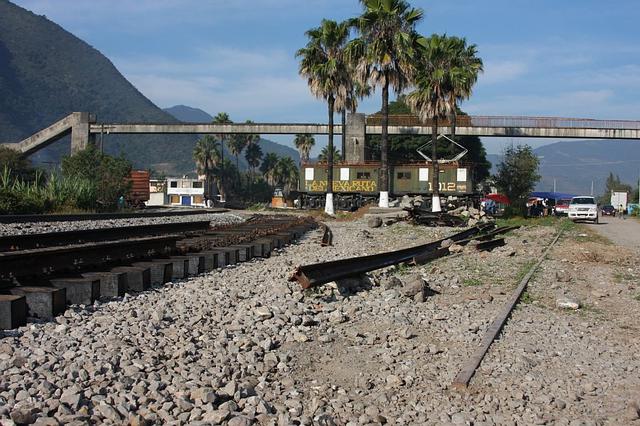
And while I was at it, I located another locomotive from this same series plinthed in Orizaba, the next city up the line from Mendoza. Mexicano 1002 is plinthed along the main drag there and if you play with Street View a little you can actually read the plaque next to the locomotive, which states that it was put in that location in 1975. More information for the roster!
So that leaves only one big question mark in Mexico: Veracruz streetcar 15, a single-truck open car similar to the others from that system preserved hither and yon, which is supposed to be plinthed in a place called Villahermosa in Veracruz province. Trouble is, I can't find any record whatsoever that it still exists. It's probably a candidate to be taken off of the roster but does anyone know for sure?
Wednesday, September 20, 2017
San Diego PCC update
I've updated a few records for PCC cars owned, and formerly owned, by San Diego Vintage Trolley. This has become a bit of a chore given changes in direction and renumberings but I think I've got it down:
Cars in service:
SDVT 529 - ex-SLPS 1716, ex-Muni 1122, acquired 2005, into service 2011
SDVT 530 - ex-TCRT 329, ex-PSCT/NJT 10, acquired 2012, into service 2014
Undergoing rebuild for service on SDVT:
SDVT 531 - ex-PTC/SEPTA 2186, acquired 2009, assigned number 532 until sometime around 2014
Not in service and stored on-site for potential future use on SDVT:
SDVT 533 - ex-PTC/SEPTA 2785, acquired 2010, has not been repainted or renumbered
Cars not in service and stored off-site in the east:
NJT 16 - ex-TCRT 335, acquired 2014
NJT 24 - ex-TCRT 363, acquired 2014
Being stripped for parts by SDVT:
Muni 1123 - ex-SLPS 1728, acquired 2005, assigned number 530 until sometime around 2014, being used as a parts source for SDVT 531
Sold by SDVT to San Diego Electric Railway Association in 2013:
"SDER 539" - ex-SLPS 1777, ex-Muni 1170, acquired by SDVT 2006, assigned number 531 until 2013, at that time was cosmetically restored (in SDER colors) for SDERA and numbered 539
I suppose the initial fleet was going to consist of cars numbered 529-532 (ex-1122, 1123, 1170, and 2186) with 533 (ex-2785) added on about 2010; then in the early 2010s, when ex-Newark cars became available, this changed. Car 529 was finished, 530 made into a parts source and an ex-Newark car assigned number 530, 531 sold, and 532 moved up in the queue and assigned number 531. Car 2785, originally assigned 533, may not receive that number but is apparently in storage intact. I should note that the car sold in 2013 to SDERA has been altered in the roster and listed as Muni 1170 but with a notation that it is lettered SDER 539, a "fictitious" designation as it never wore that number or that livery in service.
Cars in service:
SDVT 529 - ex-SLPS 1716, ex-Muni 1122, acquired 2005, into service 2011
SDVT 530 - ex-TCRT 329, ex-PSCT/NJT 10, acquired 2012, into service 2014
Undergoing rebuild for service on SDVT:
SDVT 531 - ex-PTC/SEPTA 2186, acquired 2009, assigned number 532 until sometime around 2014
Not in service and stored on-site for potential future use on SDVT:
SDVT 533 - ex-PTC/SEPTA 2785, acquired 2010, has not been repainted or renumbered
Cars not in service and stored off-site in the east:
NJT 16 - ex-TCRT 335, acquired 2014
NJT 24 - ex-TCRT 363, acquired 2014
Being stripped for parts by SDVT:
Muni 1123 - ex-SLPS 1728, acquired 2005, assigned number 530 until sometime around 2014, being used as a parts source for SDVT 531
Sold by SDVT to San Diego Electric Railway Association in 2013:
"SDER 539" - ex-SLPS 1777, ex-Muni 1170, acquired by SDVT 2006, assigned number 531 until 2013, at that time was cosmetically restored (in SDER colors) for SDERA and numbered 539
I suppose the initial fleet was going to consist of cars numbered 529-532 (ex-1122, 1123, 1170, and 2186) with 533 (ex-2785) added on about 2010; then in the early 2010s, when ex-Newark cars became available, this changed. Car 529 was finished, 530 made into a parts source and an ex-Newark car assigned number 530, 531 sold, and 532 moved up in the queue and assigned number 531. Car 2785, originally assigned 533, may not receive that number but is apparently in storage intact. I should note that the car sold in 2013 to SDERA has been altered in the roster and listed as Muni 1170 but with a notation that it is lettered SDER 539, a "fictitious" designation as it never wore that number or that livery in service.
Tuesday, September 19, 2017
A selection of Cleveland streetcars
Looking into Cleveland Railway 0140, the single-trucker preserved at the Henry Ford Museum, got me thinking about preserved streetcars from Cleveland. There aren't very many streetcars from Cleveland still around, but the ones that are still around actually offer a reasonable cross-section of the city's electric railway history. Unlike, say, Los Angeles or Chicago, though, where the majority of the city's preserved streetcars are in one place, the extant Cleveland cars are scattered across the continent.


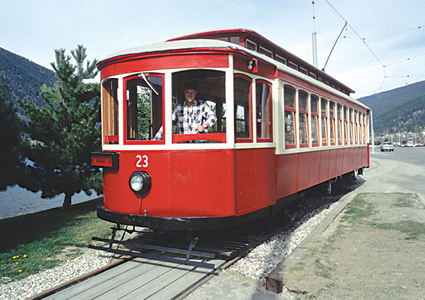
The oldest is car 0140, a Brill product fairly typical of 1890s single-truckers. It's preserved in Michigan, only a few hours from its home. The second oldest is a rather significant car: Municipal Traction 3334, later Cleveland Railway 934 and eventually Nelson Electric Tramway 23. Its design isn't particularly significant, as it's basically a catalog model Brill semi-convertible (albeit built by Stephenson, by then a Brill subsidiary, and modified several times during its life). But it was built for Municipal Traction, the "three cent line" championed by Cleveland mayor Tom Johnson in his populist fight against Cleveland Railway. An extensive account of this fight can be found here. Municipal Traction used a car numbered 3333 for promotional purposes to highlight its three cent fare and this car was numbered just one higher. Eventually it found its way out to western Canada, where it ran in Nelson and eventually became a grounded body. The Nelson Electric Tramway Society has restored it to operation on their riverfront streetcar line.
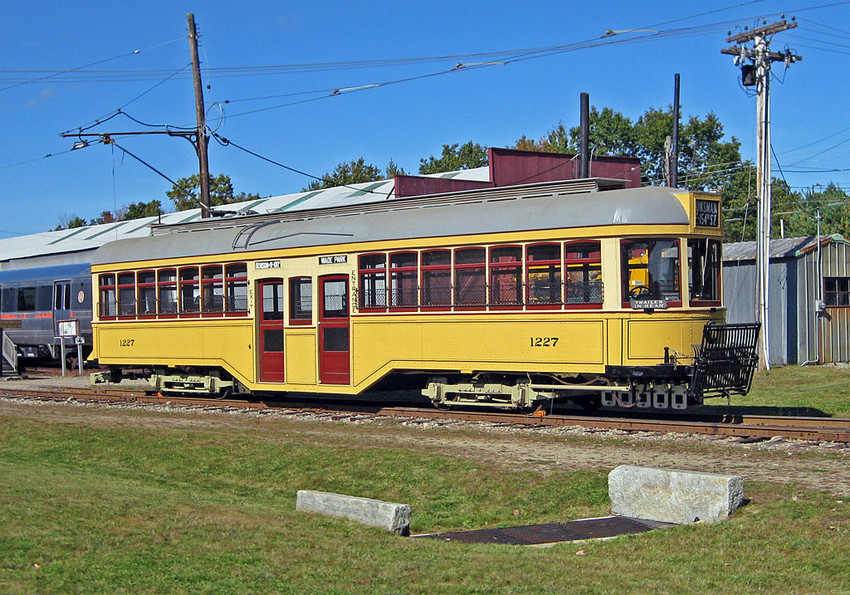
The result of Mayor Johnson's campaign for enforced low fares in Cleveland was that the street railway sought to lower its costs on a per-rider basis. This meant bigger cars and motor-trailer trains to reduce manpower requirements. Thus the next-oldest Cleveland cars are the big center-door cars built by Kuhlman in 1914, of which the best example is likely car 1227, restored to original condition by the Seashore Trolley Museum at great expense. It is likely to eventually be paired with matching trailer 2365 from 1917, currently intact but awaiting restoration work. These cars are large for streetcars, about 50' long each, and seat about 60 people (compared with a seating capacity of just 44 for the standard Chicago car around 1910, the "Old Pullman"). Thus in Cleveland in 1920 you could transport 120 seated passengers with a crew of three, whereas in Chicago you'd need twice as many employees and three streetcars to move that many seats.
The next step in Cleveland streetcar progression was the Peter Witt. None of the city's earliest 1915-built examples survive, nor do the later 1920s Kuhlman cars that ran well into the 1950s. But two examples survive that were actually diverted to Cleveland in 1918 from an order placed by the streetcar company in Rochester, New York. Cleveland Railway 1079 ran in Cleveland for only five years until it was sold for use in London, Ontario in 1923; later it went to Saskatoon, Saskatchewan, where it was retired in 1951 and is preserved (apparently in complete condition, though I've never seen a photo of this car taken in recent decades) at the Edmonton Radial Railway Society.

It's unfortunate that none of the more modern city cars that ran in Cleveland were preserved, particularly the newer Peter Witts and the famous articulated cars, until the PCC era is reached, by which time Cleveland Railway had become Cleveland Transit System. One PCC car built for CTS by Pullman in 1946, car 4223, is being fully restored by the Illinois Railway Museum. The most interesting aspect of this car's design is arguably that it's thought likely that it belongs to a series of cars originally ordered for Baltimore, but cancelled following takeover of that city's streetcar lines by Baltimore Transit. Certain obscure design features in the 1946 Cleveland cars suggest specifications issued by Baltimore, but documentation on this is tough to come by. Regardless, the PCC cars were the last city cars built for Cleveland and end the story begun by cars like 0140 in Dearborn.
Subscribe to:
Posts (Atom)