Monday, November 22, 2021

Lake Shore Electric car moved

Blaine Hays photo

There are four steel interurban cars from the Lake Shore Electric preserved. Car 174 is a body on trucks that was cosmetically restored by a museum in Newark, Ohio; cars 171 and 181 are car bodies stored in poor condition at Seashore and Northern Ohio, respectively; and that leaves LSE 167, the only one of the four that wasn't part of the 1918 order from Jewett. Car 167 was built by that company, too, but dates to 1915. It's been privately owned for decades, and by the 1990s had been fixed up quite nicely on the exterior. It even acquired (or kept?) truss rods and was placed on CTA 4000-series MCB trucks with some electrical equipment hung under it for appearance.

Unfortunately a quarter century sitting on a siding at a tourist railroad in Wellington, Ohio didn't do the car any favors. It has now made its way to Avon Lake, Ohio, and has been set down behind the old LSE Beach Park station. Its trucks are stored alongside it. Plans for it are uncertain, but LSE freight motor 38 was cosmetically restored (sort of) a few years ago and plinthed out in the parking lot in front of the Artstown Gallery shopping center, so perhaps car 167 will join it. Thanks to Bill Wulfert for passing along this news, which comes via a NORM newsletter.

As far as I know, the other electric car owned by the same family, an Interstate Public Service freight motor that was heavily rebuilt by American Aggregates into a diesel-electric, is still on the siding in Wellington. But corrections and updates are always appreciated.

Wednesday, November 10, 2021

Winnipeg Railway Museum closing

It's been reported that the Winnipeg Railway Museum in Winnipeg, Manitoba, is closing at the end of this year. The museum is housed in the city's railway station, which is also used by VIA and is apparently now being eyed by a public transit project. So they've lost their lease and are being evicted. The article about this event includes some fairly optimistic language from museum representatives, and it sounds like this was expected sooner or later, so hopefully they have a workable plan in place to relocate. This is just another reminder than any museum that doesn't own its own land is living on the precipice of eviction.

WRM is home to two pieces of electric equipment. The more significant, pictured above in a photo from this 2018 article, is Winnipeg Electric Railway 356. Even though the Winnipeg streetcar system remained in operation until 1955 - and was using big wooden deck-roof cars right up until the end - not a single car from the system was preserved intact. A number of cars were sold as bodies, and a handful are still around in various stages of disrepair, but this is the only streetcar from Winnipeg that can be considered preserved. As of 2018 it was undergoing restoration work.

The other is Hudson Bay Mining & Smelting 95, one of two heavily-rebuilt electric locomotives from that Flin Flon operation to be preserved. This one is an oddity: a four-wheel 250-volt switcher built by GE in 1928. I have very little information on its history or electrical/mechanical equipment.

Monday, November 8, 2021

M&O Subway cars for sale

Many thanks to Andy Nold for sending along this link to an auction of three ex-M&O/Tandy Subway electric cars. Of the three cars in question, I believe that only two are currently on the list: Tandy 1 (not to be confused with the other Tandy 1) and Tandy 4. Both of these are squared-off "Winnebago-style" Tandy subway cars whose bodies are basically of late-1970s vintage, but whose electrical and mechanical equipment - and probably portions of the frame - started out as PCC cars. Tandy 1 was built off of Boston PCC 3166, a 1945 Pullman-Standard product, while Tandy 4 was built from DC Transit 1506, a St. Louis product of similar vintage. As for the third car, which is largely gutted, I'm not even sure what its identity is. I believe that all three have been owned by North Texas Historic Transportation, but word on the street is that NTHT is either contracting or folding altogether and it appears these three cars are being auctioned off by the local transit agency. So if you want air-electric PCC car parts, here's your ticket. The cars are located in a lot here.

And if anybody has more information on the existing Tandy cars, I'd appreciate it. My roster of ex-Tandy cars (I've used Tandy interchangeably with M&O on the list although the latter preceded the former as operators of the subway line so they're really not synonymous) is a bit of a mess. Of the seven cars on that particular list, only three are what I'd consider definitely accounted for: the "other" car 1, now restored and on display; car 2, a "Winnebago" style car, owned by McKinney Avenue and currently in storage; and DC Transit 1540, an unrebuilt PCC which returned home to Maryland. The other four include two of the cars now up for auction and two other cars that were bought by Brookville. But I'm not even sure they still exist - Brookville may have scrapped them at some point - and there's evidently a third (gutted) car in that lot in Fort Worth that's not on my list. Help is needed!

MYSTERY SOLVED: The mystery of the surviving Tandy cars ended up being solved - the two Brookville cars were confirmed scrapped, and the cars up for auction described in this post failed to find buyers and were similarly cut up.

Wednesday, October 27, 2021

Hudson Valley Railway car added to list

The photo above is from the Champlain Valley Transportation Museum in Plattsburgh, New York, and, sure enough, it shows an electric car masquerading as a diner. For a while I've had this car on my "possible" list, in the category of cars that I know exist but that I don't have solid information on. But this past week I was able to pick up a book by David Nestle on the Hudson Valley Railway (shameless plug - from here) and that has allowed me to fill in just enough gaps that I'm comfortable adding the car to the PNAERC list.

So this Hudson Valley Railway car is now on the roster. Unfortunately it's got several qualities that make it something of a marginal addition. First, I don't know its fleet number; second, it's not only an incomplete body but it's also missing its ends; and third, it's preserved as a diner rather than as an electric car. But none of these is a deal-killer by itself. There are other cars on the list whose numbers are unknown. For the most part, as long as I know what series or order a car is from, I'll include it. As for how incomplete the car is, there are also other examples of cars similarly "reduced" in form. But the fact that they're preserved in a museum makes a big difference. And finally, it's not the only electric preserved as a non-electric - the diner in Tupelo and the house in Fort Smith are a couple of similar examples. Again, the key here is that the car is preserved in a museum, as I wouldn't normally include a house or a diner "in the wild."

This is, to be sure, an historically significant car, modified as it is. It's the only survivor, I believe, of the various streetcar and interurban lines that once ran through the upper Hudson Valley. Nothing from the Albany or Schenectady city systems has survived, nor has anything from the Albany-Hudson interurban line. This is also a very early example of an interurban car, dating to 1901, and is one of just eight preserved cars (and the only interurban) built by local Troy, New York car builder J.M. Jones & Sons. The car's number can be narrowed down to six candidates; part of the 21-29 series on HVR, it's known not to be 21, 24, or 26 (rebuilt, rebuilt, and burned, respectively). Perhaps someday its fleet number will come to light.

Friday, October 22, 2021

New Hope & Ivyland updates

While I was looking for something else, I stumbled upon a couple of photos that shed light on recent changes involving the New Hope & Ivyland steam tourist line in Pennsylvania. The first is that Reading MU car 870 - which heretofore has been known as SEPTA 9125, its post-rebuild "Blueliner" era number - is now in service after having been rebuilt by the NH&I. It appears they're using it as a cab car for backing up their trains, which it's obviously pretty well suited for. This car was on the wire train based out of Wayne Junction for many years, so I suspect it was stripped of a lot of its interior before it ever came to the NH&I. The Tim Darnell photo above, taken several decades ago in January 2020, is from here. Its status has been updated to "towed inoperable" which is what I use for cars like this that are in use, but not really operational per se, at least not as electrics.

And then there's a second Reading MU car, SEPTA 9123, shown in photos here and here at the NH&I. The photos, taken this past May and June, describe the car as "newly arrived" which makes sense since last I knew, it was in Hamburg, PA as part of the Reading Tech collection. Its ownership has been updated from the Reading group (which, according to my list, still has nine of these cars) to the NH&I.

Monday, October 11, 2021

Highliners scrapped

Thanks to Les Beckman for notifying me that the two Metra (ex-Illinois Central) "Highliner" MU cars at the Hoosier Valley Railroad Museum, 1502 and 1529, have been scrapped. These were two of the four "Highliners" acquired by HVRM in 2008 but they never really fit in at the museum and I believe they turned out to be less well-suited to display use than anticipated. The other pair, 1521 and 1617, were scrapped back in 2010. The remaining pair were offered to other museums earlier this year but found no takers. This is not a big historic loss; there are four "Highliners" preserved at IRM, six at the Boone & Scenic Valley, and 10 of the cars at the Museum of the American Railroad in Texas. As for HVRM, their traction collection is now down to a single Lackawanna MU car and a pair of privately-owned South Shore cars stored on their property.

Friday, October 8, 2021

NYCTA cars added to list

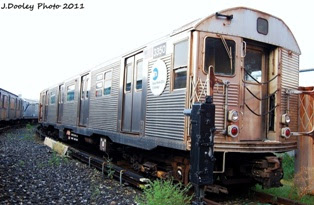
It was pointed out to me that a pair of NYCTA type R32 subway cars, cars 3350 and 3351, have been missing from the PNAERC list even though they're part of the New York Transit Museum collection and stored with the NYCTA historic fleet at Coney Island Yard. Many thanks to Bill Wall for correcting my earlier erroneous information that these cars were owned by Railway Preservation Corporation!

As you may have guessed from the links, these cars have now been added to the list. They were built by Budd in 1964 and make up a married-pair set. They're known as "phase II" R32's following a major rebuild in the late 1980s. A bunch of R32's remained in service until about a year ago (later than expected due to issues with newly-delivered replacement cars) which is an awfully impressive service life. I'm not sure when 3350 and 3351 were assigned to the NYTM but Bill commented that it was some time after 2008, the year the other preserved set of R32's - identical pair 3352 and 3353 - were transferred to the museum collection.
And in unrelated news, I've been able to update a bit of information about a car at the Illinois Railway Museum. The only unidentified (as in, unknown fleet number) car in the IRM collection was a 1913 streetcar body from Tri City Railway & Light in Rock Island, IL. That's no longer the case and the car has been IDed as TCR&L 483, part of the 451-485 series constructed by American. It is the only known streetcar from Rock Island to survive. Its PNAERC record has been updated to add its fleet number. (The photo above, taken by yours truly in 2001 when this car was unloaded at IRM, is the only picture I've ever seen of it at IRM before it was hurriedly tarped.)